Film Thickness, Adhesion, and Coating: Matching Laminating Film Parameters to Substrate Needs
Laminating film performance is decided by three variables that can be specified before a single sheet passes through a laminator: total film thickness, the PET/EVA composition of the film, and the functional coating applied to its surface. Thickness sets stiffness, edge protection and curl behaviour. PET/EVA composition sets clarity, dimensional stability and the temperature window in which the adhesive bonds. Coating chemistry — anti-static, anti-yellowing, UV-resistant — sets how the finished sheet behaves in the environment it is going into. Match these three parameters to the substrate and the result is a flat, bubble-free, permanently bonded sheet. Mismatch them and the failure usually appears weeks later as haze, curl or edge lift.
Why Lamination Fails When Parameters Are Chosen by Habit
Most lamination defects are specification problems before they are machine problems. Buyers typically select a pouch or a roll by size and price, then adjust the laminator until the output looks acceptable on the day of the test. The defects that follow are predictable and repeatable:
- Edge lift and delamination — the EVA adhesive never reached bonding temperature across the full sheet, or the total film thickness was too thin to hold a rigid substrate flat.
- Bubbles and clouding — moisture inside the paper or coated stock flashed into vapour faster than it could escape through the adhesive layer.
- Curl — the PET carrier and the EVA adhesive contracted at different rates as the finished sheet cooled.
- Yellowing and haze — progressive degradation of the carrier polymer over months of light exposure, especially in daylight-facing applications.
- Static cling and double-feeding — uncoated film surfaces holding an electrostatic charge inside automated handling equipment.
Substrate choice drives every one of these outcomes. Uncoated paper, coated paper, photo stock, laser toner, inkjet ink and PVC cards each absorb heat and moisture differently. A parameter set that produces a flawless result on one substrate will fail on another, which is why the specification has to be written against the substrate, not against the machine.
Industry Background: Why Parameter Discipline Matters Now
The category is large and still expanding. DataM Intelligence values the global lamination films market at approximately USD 6.84 billion in 2024, with Asia-Pacific accounting for a 36.87% revenue share in the same year, and projects a CAGR of 7.0% from 2025 to 2032.
Market size figures should be read with care, because research houses scope the category differently. Market Research Future values the laminating film market at USD 3.40 billion, while Grand View Research reports USD 6.55 billion for the adjacent packaging laminates market, in which plastic-based materials held a 57.31% share in 2024. The pattern matters more than the decimal: PET-based carrier chemistry is the dominant material base, and demand is concentrated in Asia-Pacific manufacturing.
Three background shifts directly affect how a buyer writes a lamination specification today:
- High-micron specifications are moving into the mainstream. Trade reporting published by Accio Work identifies high-micron thermal pouches in the 80–150 micron band, together with A4 150-micron sheets, among the top-selling segments in document protection.
- Brand-side names set expectations, not film supply. Market Research Future lists 3M, ACCO Brands (GBC), Avery Dennison and Fellowes among the major global players in the laminating film market. Most of these businesses convert and distribute film rather than extruding the base structure, which means parameter control happens further down the chain, at the film and pouch manufacturing stage.
- Application-level regulation is tightening. According to AFNOR Group, laminating films intended for toy-related applications, or for items children might touch, must comply with EN 71-3 chemical migration limits in the EU.
The Detailed Solution: Three Parameters, One Bond
Every thermal laminating film is built from the same two functional layers — a PET carrier and an EVA adhesive — and finished with an optical or functional treatment. Thickness, ratio and coating are the three levers a buyer can pull.
1. Thickness: What 35 to 250 Microns Actually Changes
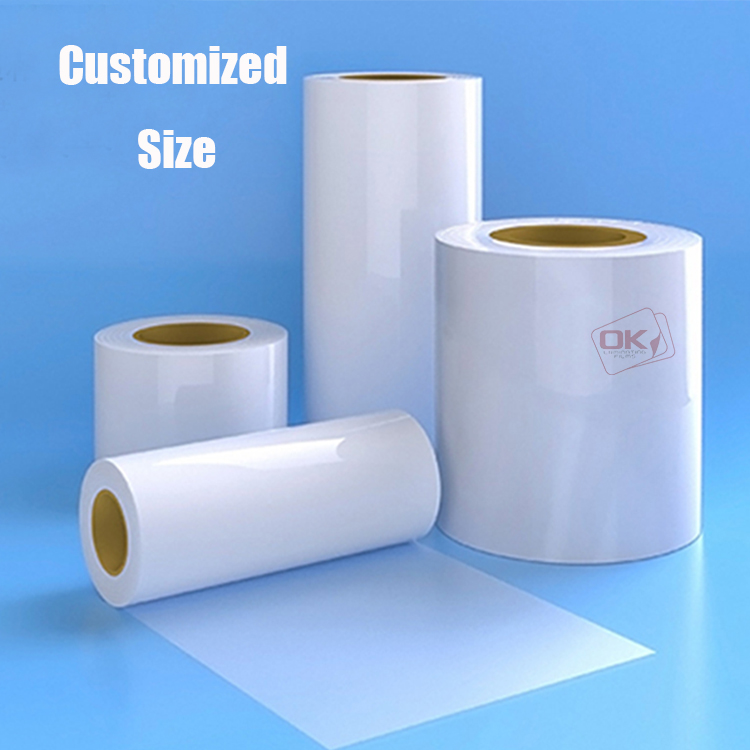
Total laminating film thickness is the sum of the structural and adhesive layers. HADA's thermal laminating roll film, model HD-RL, covers a 35mic to 250mic thickness range at widths from 100mm to 1300mm, with length and packaging customized to the order. Pouch formats work on the same principle at fixed sizes: the HD-A4-80MIC pouch is 80mic with a 50/30 PET-to-EVA split, and the Letter-size 229 × 292mm pouch is offered at 3Mil/75mic with a 38/37 split and at 5Mil/125mic with a 75/50 split.
The practical consequences of thickness are consistent across formats:
- 35mic–50mic: highly conformable film for flexible substrates, labels and low-rigidity work where a stiff finish would crack or lift.
- 75mic–80mic: the standard working range for office documents, certificates and general print finishing, balancing protection with flexibility.
- 125mic and above: a rigid, card-like finish for ID cards, badges, menus, book covers and signage. Higher thickness requires more heat and slower throughput, and raises material consumption per sheet.
The composition ratio matters as much as the headline number. An 80mic pouch built 50/30 carries more PET carrier than a 75mic pouch built 38/37, so two products with similar total thickness can behave very differently in the same laminator. Buyers comparing 80mic laminating pouches against 125mic laminating pouches should compare the split, not only the total.
2. PET/EVA Composition: Where Clarity and Stability Come From
PET (polyethylene terephthalate) is the structural carrier. It provides dimensional stability under heat, optical clarity and the flatness that keeps a laminated sheet from bowing after cooling. EVA (ethylene-vinyl acetate) is the adhesive layer: it melts inside the working temperature window of a standard thermal laminator, flows into the surface profile of the substrate, and bonds to paper fibre, toner and ink.
The ratio between the two layers is the main design lever:
- More EVA relative to PET (as in a 38/37 split) improves flow and adhesion on porous, textured or heavily inked substrates.
- More PET relative to EVA (as in a 50/30 split) produces a stiffer, flatter sheet with higher clarity and a lower risk of curl.
HADA's laminating pouches and HD-RL laminating roll film are both built on a PET + EVA structure and are specified as suitable for all standard thermal laminators, which keeps the format decision separate from the equipment decision.
3. Coating: Anti-Static, Anti-Yellowing and UV Behaviour
Anti-static. A film with anti-static properties dissipates surface charge instead of holding it. In production this reduces dust attraction between film and sheet, prevents double-feeding in automated pouch feeders, and stops finished sheets from clinging to each other in stacks. HADA specifies anti-static properties as a defined requirement for electronic-component-related applications.
Anti-yellowing. Yellowing is a slow chemical change in the carrier polymer, not a surface stain. Anti-yellowing film is engineered for long-term preservation — certificates, archival documents, menus and signage that sit in daylight for years. It is the parameter that separates a film that still looks clear after storage from one that has turned amber.
UV resistance. Where the laminated item faces direct solar exposure, such as advertising posters and banners, UV resistance protects both the carrier film and the printed image beneath it. HADA lists UV resistance as a special requirement for outdoor use.
Finish. Glossy and matte are optical treatments of the same base film. Glossy maximises light transmission and colour vibrancy, which matters for photo and digital printing. Matte reduces glare and surface reflection, hides fingerprints and accepts certain pen markings. Both finishes are available across HADA's pouch and roll formats.

Measurable Performance: What HADA's PET/EVA Formulation Is Specified To Deliver
Parameter choices only matter if the film behaves predictably. HADA specifies three performance deltas for its PET/EVA laminating film: light transmittance 15% higher, shrinkage rate 20% lower, and tear strength 25% higher. Each figure maps to a specific production problem.
- Light transmittance (15% higher). Higher transmission means less grey veil sitting over the printed image. This is the parameter that decides whether a laminated photo, certificate or badge looks like the original or looks slightly dulled. It matters most in photo and digital printing, ID card and badge work, and any application where the laminated sheet is the finished product rather than an internal document.
- Shrinkage rate (20% lower). Shrinkage during cooling is the root cause of curl. A lower shrinkage rate means the film contracts less as it leaves the laminator, so sheets stay flatter, stack more predictably and hold their edges during later handling. On high-micron pouches used for cards and menus, lower shrinkage is the difference between an item that stays flat in a wallet and one that bows within a week.
- Tear strength (25% higher). Higher tear strength extends the working life of anything handled repeatedly — menus, ID badges, packaging labels and signage. It is a durability figure rather than a visual one, and it becomes relevant the moment a laminated item leaves controlled office storage.
These are film-level specification figures. Actual bonding performance still depends on the substrate, the laminator settings and the operator, so the correct way to validate them is a sample run on your own material at production speed rather than a bench test on a single sheet.
Behind the specification sits the production capability that makes it repeatable: three automated production lines, a 40,000 square metre facility, approximately 200 staff, and 22 national patents covering functional laminating film development, with certifications including ISO 9001, BSCI, SMETA, ROHS and REACH.
Matching Parameters to Substrates: A Step-by-Step Breakdown
- Identify the substrate and how it was printed. Establish whether the sheet is uncoated paper, coated stock, photo paper, a PVC card, or a synthetic label, and whether the image was applied by laser toner, inkjet or offset ink. Heavy toner coverage and inkjet output hold different amounts of moisture and release it at different rates.
- Choose total thickness from the mechanical requirement. Flexible substrates need 35mic–50mic. Office documents and certificates sit at 75mic–80mic. Items that must hold a rigid shape — ID cards, badges, menus, book covers — need 125mic or higher.
- Check the PET/EVA split, not just the micron figure. Porous and heavily inked substrates benefit from a higher EVA proportion; substrates that must stay perfectly flat benefit from a higher PET proportion.
- Select finish and coating. Glossy for colour vibrancy and photo work; matte for glare reduction and fingerprint resistance. Add anti-static where automated feeding or electronic-component proximity applies, anti-yellowing for long-term preservation, and UV resistance for outdoor placement.
- Set the laminator to the adhesive, not to habit. Temperature, speed and pressure must be matched to the EVA ratio and the total thickness. Thicker film and heavier PET content require more heat and slower throughput.
- Run a sample and measure the outcome. Check for bubbles and wrinkles, confirm cold-peel adhesion at the edges, and let the sheet rest before measuring curl. Confirm dimensional accuracy against the original.
- Verify documentation and repeatability. Request certification scope and product-level test data for the specific SKU, then confirm the parameters hold at production volume rather than at sample volume.
Use Cases: Which Parameter Set Fits Which Job
HADA laminating film is used across office supplies, education and school, retail and stationery, advertising and graphic, printing and packaging, photo and digital printing, and ID card and badge industries. The parameter logic for the most common jobs is straightforward:
- ID cards and badges: 5Mil/125mic pouches for rigidity and dimensional stability, with anti-static properties where cards run through automated handling equipment.
- Certificates and archival documents: 80mic A4 pouches with anti-yellowing protection, prioritizing clarity and long-term preservation over stiffness.
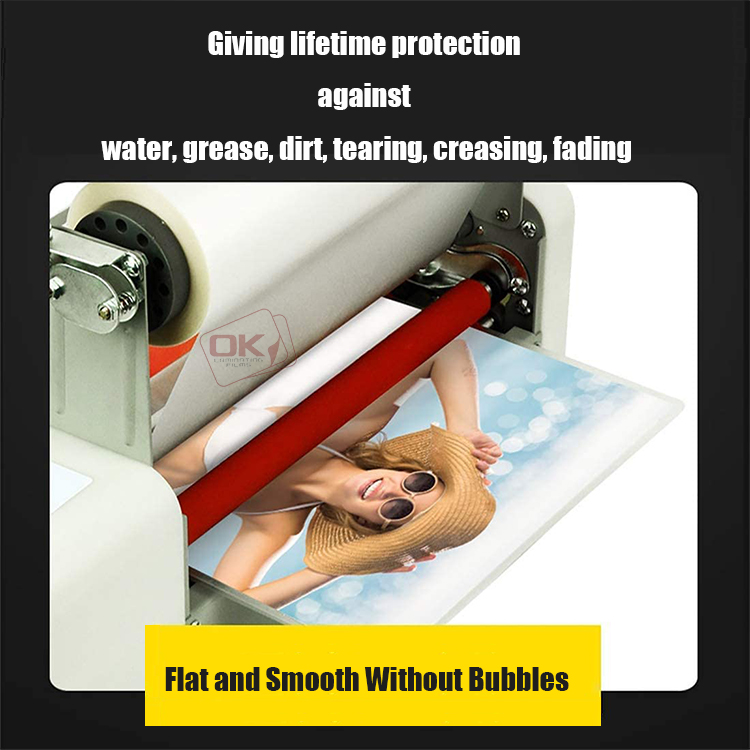
- Photo and digital printing: high light transmittance film with a no-bubble, no-wrinkle finish, since the laminated sheet is the delivered product.
- Menus and book covers: 125mic film in glossy or matte, leveraging the waterproof and scratch-resistant surface that repeated handling demands.
- Packaging and labels: HD-RL roll film cut to custom widths, in the lower to mid thickness band where conformability matters more than rigidity.
- Advertising posters and banners: roll film with UV resistance for outdoor placement, in mid to high micron specifications.
- Electronic-component-related documents: anti-static film, where static discharge and dust attraction are the primary risks.
- Office, education and retail output: 80mic A4 pouches and 3Mil/75mic Letter-size pouches as the default high-volume formats.
Comparison Table: HADA Formats and Their Parameter Envelope
All three formats share the same base construction and specification claims: high transparency, no bubble and no wrinkle, strong adhesion, waterproof and scratch-resistant surfaces, anti-yellowing for long-term preservation, and suitability for all standard thermal laminators.
| Format | Model | Material | Thickness | Size / Width | Finish | Packaging |
|---|---|---|---|---|---|---|
| Thermal laminating roll film | HD-RL | PET + EVA | 35mic – 250mic | Width 100mm – 1300mm; length customizable | Glossy / Matte | Customizable |
| A4 laminating pouches | HD-A4-80MIC | PET + EVA | 80mic (50/30) | A4 (216 × 303 mm) | Glossy / Matte | 100 pcs/pack, 10 packs/carton |
| Letter-size laminating pouches | 229*292*3mil/5mil | PET + EVA | 3Mil/75mic (38/37); 5Mil/125mic (75/50) | Letter (9 × 11.5 in / 229 × 292 mm) | Glossy / Matte | 100 pcs/pack, 10 packs/carton |
The second table converts the same parameters into a starting specification per job. Treat it as a first draft to be validated by sampling, not as a substitute for a trial run.
| Substrate / job | Starting thickness | Coating and finish priority | Format |
|---|---|---|---|
| Office documents, certificates | 80mic | Anti-yellowing; glossy for clarity, matte for glare control | A4 pouches |
| Photo and digital print | 80mic – 125mic | High light transmittance; anti-static to limit dust pickup | A4 / Letter pouches |
| ID cards and badges | 125mic | Dimensional stability; anti-static for automated handling | Letter-size pouches |
| Menus, book covers | 125mic | Waterproof and scratch-resistant; glossy or matte | Letter pouches or roll film |
| Packaging and labels | 35mic – 75mic | Conformability; FDA food contact compliance where applicable | HD-RL roll film |
| Outdoor posters and banners | Mid to high micron | UV resistance | HD-RL roll film |
| Electronic-component-related items | As specified by the job | Anti-static | Pouches or roll film |
Frequently Asked Questions
What certifications and compliance documents should a buyer request before ordering laminating film?
Guangzhou Huada Laminating Film Co., Ltd. holds ISO 9001, BSCI, SMETA, ROHS and REACH certifications, alongside 22 national patents covering its functional laminating film development. Supplier-level certificates are only the starting point. Buyers should confirm which application-level rules apply to the finished item: laminating films used for toy-related applications, or for items children are likely to touch, must comply with EN 71-3 chemical migration limits in the EU, food-contact applications require FDA compliance, outdoor applications require UV resistance, and documents processed near electronic components typically require anti-static properties. Ask for the certificate scope and product-level documentation for the specific SKU, not just a certificate number.
What thickness and size ranges can HADA manufacture?
HADA's thermal laminating roll film (HD-RL) is produced in a 35mic to 250mic thickness range at widths from 100mm to 1300mm, with length and packaging customized to the order. Pouch formats include the A4 HD-A4-80MIC at 80mic with a 50/30 PET-to-EVA split and a 216 × 303mm size, and Letter-size 229 × 292mm pouches at 3Mil/75mic (38/37 split) and 5Mil/125mic (75/50 split). Both gloss and matte finishes are available, and the pouches are packed 100 pieces per pack and 10 packs per carton. All formats are specified as suitable for standard thermal laminators. Buyers with non-standard size requirements should confirm availability during quotation.
What actually drives the cost of laminating film?
Four factors dominate. First, total thickness and the PET/EVA ratio: a 50/30 construction consumes more PET carrier than a 38/37 construction at a similar headline micron figure, so material content — not the micron number alone — drives the price. Second, functional coatings: anti-static, anti-yellowing and UV-resistant treatments add process steps that a plain film does not require. Third, size and format: roll film is priced on width and length, pouches on size and pack configuration. Fourth, packaging customization and order volume. The practical comparison method is cost per square metre of coverage on your actual substrate, validated by a sample, rather than cost per pack.
Can we test laminating film on our own substrate before committing to volume?
Yes. Sample validation is the only reliable way to confirm a parameter set, because the bonding result depends on the substrate, the ink or toner system and the laminator settings as much as on the film. When you request a sample, specify the format (A4, Letter-size or roll), the thickness and split you want to test, the finish (glossy or matte), and any functional requirement such as anti-static, anti-yellowing or UV resistance. Run the trial at production speed, then check for bubbles and wrinkles, edge adhesion after cooling, curl after a rest period, and dimensional accuracy against the original. Samples can be requested through the contact details below.
How is production and delivery structured for volume orders?
HADA operates three automated production lines at a 40,000 square metre facility in Guangzhou, with annual capacity exceeding 10,000 tons and approximately 200 staff. Around 80% of output is exported to North America, South America, Europe, Australia and Southeast Asia, across more than 50 countries and regions. The site is a 30-minute drive from Baiyun International Airport with access to the major Guangzhou and Shenzhen ports. Because lead time depends on thickness, size, customization and packaging, it is confirmed at the order stage against your specification rather than quoted as a fixed figure. To move forward, send your specification to sales@huada168.com or request a sample, quotation and product catalog at www.huada168.com.
Conclusion: Specify the Variables, Not Just the Part Number
A laminating film order that lists only a size and a micron figure leaves the three variables that actually determine success unmanaged. Thickness decides whether the finished item stays flat and how much protection it carries. The PET/EVA split decides how the adhesive performs on your specific substrate and whether the sheet curls after cooling. Coating chemistry decides whether the laminated item still looks clear in two years, whether it survives an outdoor installation, and whether it can run through automated equipment without static problems.
HADA has manufactured functional laminating film since 1992, with more than 33 years of experience in PET/EVA pouch and roll production, and exports the majority of its output to buyers who write specifications exactly this way. The three performance figures behind its film — 15% higher light transmittance, 20% lower shrinkage rate and 25% higher tear strength — exist to make those specification decisions predictable, provided they are validated on your own substrate before volume production begins.
Request a Sample, Quotation or Catalog
Send your specification — format, thickness and PET/EVA split, finish, and any anti-static, anti-yellowing or UV requirement — and HADA will match it to the correct pouch or roll construction.
- Website: www.huada168.com
- Email: sales@huada168.com / brian@huada168.com
- Phone: +86-20-87451312
- WhatsApp: +8618929589411
- Address: No.15, Shantangpai Road, Gaoweiqiang, Jinpen Village, Zhongluotan Town, Baiyun District, Guangzhou, Guangdong Province, China

Have Questions or Need More Details?
Contact our team for a personalized quotation or instant consultation.
Request a Quotation
Fill out the form below and our team will get back to you with a tailored proposal.
WhatsApp Direct Chat
Prefer to chat in real-time? Message us on WhatsApp for instant assistance & quick answers.
- Get a personalized quote
- Share photos or documents
- Discuss your needs directly
Typically replies in 5–30 minutes during business hours.