Laminating Rolls for Educational & Retail Projects: A Practical Application Guide for High-Traffic Uses
Laminating Rolls for Educational & Retail Projects: A Practical Application Guide for High-Traffic Uses
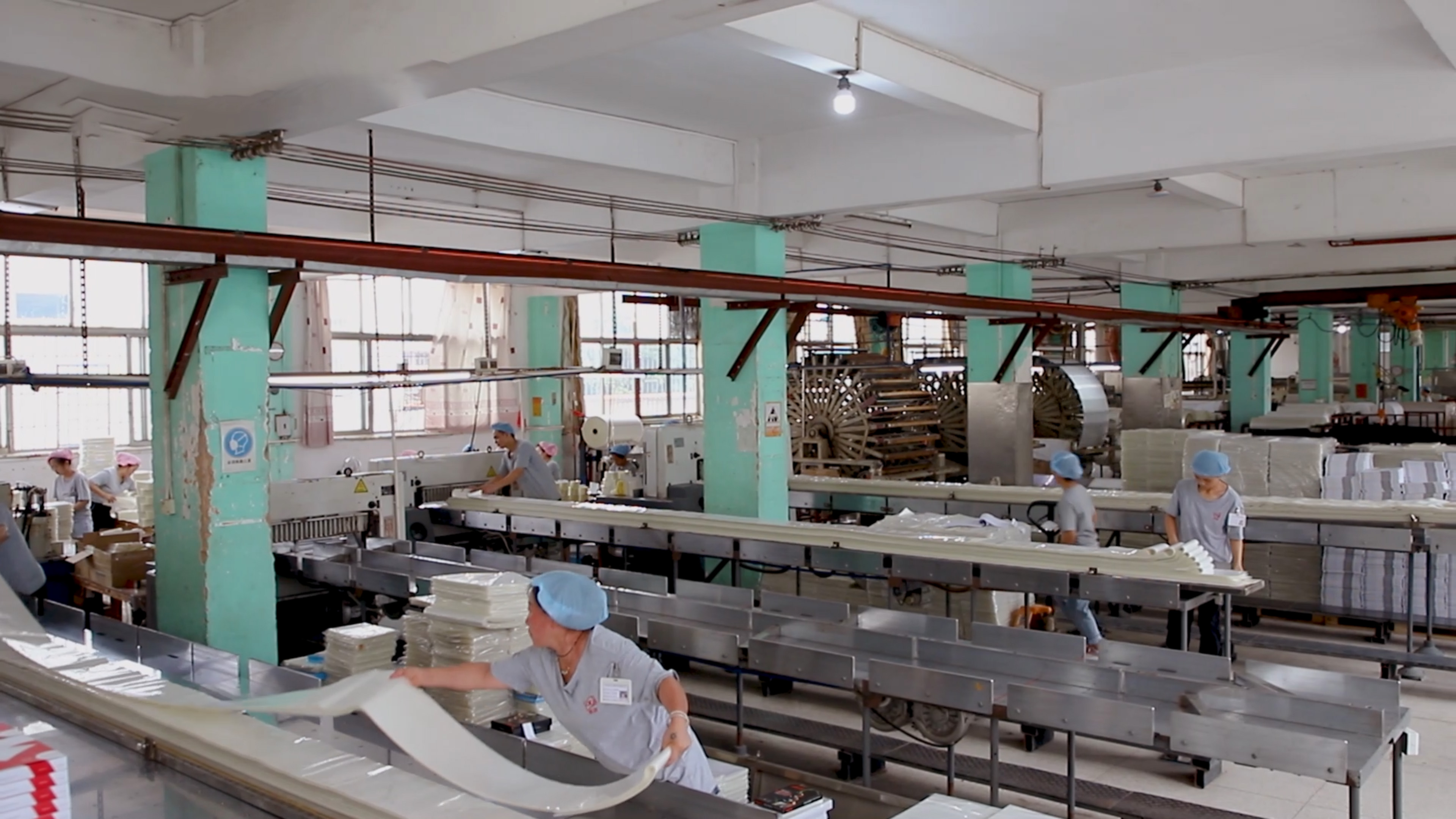
Slitting laminating roll film to project widths at HADA's Guangzhou facility. Roll width is set between 100 mm and 1,300 mm, and roll length is customizable per order.
Education and retail projects wear out laminated material in ways a packaging specification rarely captures. A laminated school book cover is handled by students every school day for a full academic year. A canteen menu is wiped after every service. A shelf label is peeled, re-priced and re-stuck on a weekly cycle. A window poster sits in daylight for months. The laminating roll behind those items has to resist water, abrasion and yellowing, and it has to run cleanly on the laminator the school, library or print shop already owns.
The rest of this guide works through the problem, the supply background, the specification steps, the application scenarios and a requirement-by-requirement comparison table, then answers the five questions buyers raise most often before a first order.
Why High-Traffic Education and Retail Projects Stress Laminating Rolls Differently
A packaging line laminates a product once and seals it into a distribution chain. An education or retail project laminates an object that then goes into public hands, and the laminate becomes the surface everything else touches. That shift changes which properties matter, and it changes which failures are simply not acceptable.
Four failure patterns dominate these projects:
- Edge delamination. Book covers, cards and labels are trimmed after lamination, so the trimmed edge is the exposed seam. Repeated flexing and stacking stress that seam long before the film body fails.
- Water and cleaning damage. Menus, table cards, shelf talkers and canteen signage are wiped with water or cleaning agents. A laminated surface that absorbs liquid or lifts at the edge fails the first cleaning shift.
- Surface abrasion. Items travel through school bags, trolleys, cash drawers and shelf-edge rails. Scuffing appears first as lost gloss or lost clarity, then as visible haze over printed content.
- Yellowing on display. Posters and signage in daylight lose neutrality over months, which is a print-quality problem rather than a structural one, and it is usually noticed before any physical defect.
Rolls also create machine-side risk. Thin film fed at speed can build static, and static shows up as misalignment, wrinkles and inconsistent tension — the flat, bubble-free result a buyer expects depends on the film and the machine setting together. HD-RL lists 'No Bubble & No Wrinkle' and 'Strong Adhesion' among its product features; on site, both still have to be demonstrated at the operating speed of the project's own laminator.
One organisational difference matters as much as the physics. In schools, libraries and retail chains the person selecting the roll is often not a lamination specialist. The specification therefore has to be short, written and testable. That is the logic behind the step-by-step breakdown later in this guide.
Industry Background: What the Film Supply Picture Looks Like
Film supply itself is not the constraint. DataM Intelligence valued the global lamination films market at US$ 6,842.11 million in 2024, with food and beverage as the primary end-user segment. Two narrower estimates describe adjacent scopes: Data Bridge Market Research valued BOPP thermal lamination films at US$ 3.5 billion in 2024 with a projected 5.2% CAGR through 2033, while Future Market Insights valued PET (BOPET) films for packaging at US$ 10.3 billion in 2024. Those figures measure different product scopes and should not be added together. Read together, they describe a mature, capacity-rich supply base in which differentiation comes from specification control rather than scarcity.
Geography shapes lead time and specification habits. Asia Pacific held a 36.87% revenue share of the lamination films market in 2024 (DataM Intelligence), consistent with the volume of China-based roll film reaching education and retail tenders in Europe, North America and Australia. HADA, for instance, exports to more than 50 countries and regions from Guangzhou, with 80% of output exported and main markets in North America, South America, Europe, Australia and Southeast Asia.
Two standards are worth keeping in the project file because they turn adjectives into comparable evidence. ASTM D882 is the standard test method for tensile properties of thin plastic films less than 1.0 mm thick, so when two rolls are both described as strong, a tensile result under ASTM D882 is the comparable item. Commission Regulation (EU) No 10/2011 governs plastic materials and articles intended for food contact in the EU and sets migration limits plus a positive list of substances — relevant where laminated menus or counter cards may touch food directly.
The Solution Set: What a Thermal Laminating Roll Has to Deliver
HADA is a Guangzhou-based manufacturer dedicated to the R&D, production and sales of functional laminating films, founded in 1992, holding 22 national patents and certifications including ISO 9001, BSCI, SMETA, ROHS and REACH. Its HD-RL thermal laminating roll is the format this guide focuses on, because roll film is what high-traffic stationery, signage and label work actually consumes.
Documented HD-RL specification
- Material: PET and EVA.
- Thickness range: 35 micron to 250 micron.
- Width range: 100 mm to 1,300 mm.
- Length: customizable per request.
- Finish: glossy and matte.
- Packaging: customizable per request.
- Product features: high transparency; no bubble and no wrinkle; strong adhesion; waterproof and scratch-resistant; anti-yellowing for long-term preservation.
- Machine compatibility: suitable for all standard thermal laminators.
- Applicable industries: office supplies; education and school; retail and stationery; advertising and graphic; printing and packaging; photo and digital printing; ID card and badge.
Two of those features carry most of the weight in education and retail work. Waterproof and scratch-resistant covers the wipe-and-handle reality of menus, table cards, price tags and book covers. Anti-yellowing for long-term preservation covers the display reality of window posters, shelf signage and library book jackets, where the laminate may stay in daylight far longer than the printed sheet inside it.
Finish choice is a project decision rather than a quality hierarchy. Glossy film is the usual choice where colour saturation and contrast carry the message — promotional posters, product signage, photo printing. Matte film is the usual choice where interior lighting produces glare or where an item is touched constantly, because a matte surface scatters light and shows handling marks less readily. Both finishes are available in the HD-RL range, so the same supply relationship can cover a school's book-cover programme and a store's signage at once.
Customization is the part that makes roll film practical for distributors and multi-site retail buyers. HADA provides OEM/ODM production with customization of product size, thickness, logo and packaging — the combination that allows a distributor to ship school-branded or store-branded rolls without holding a second inventory of film.
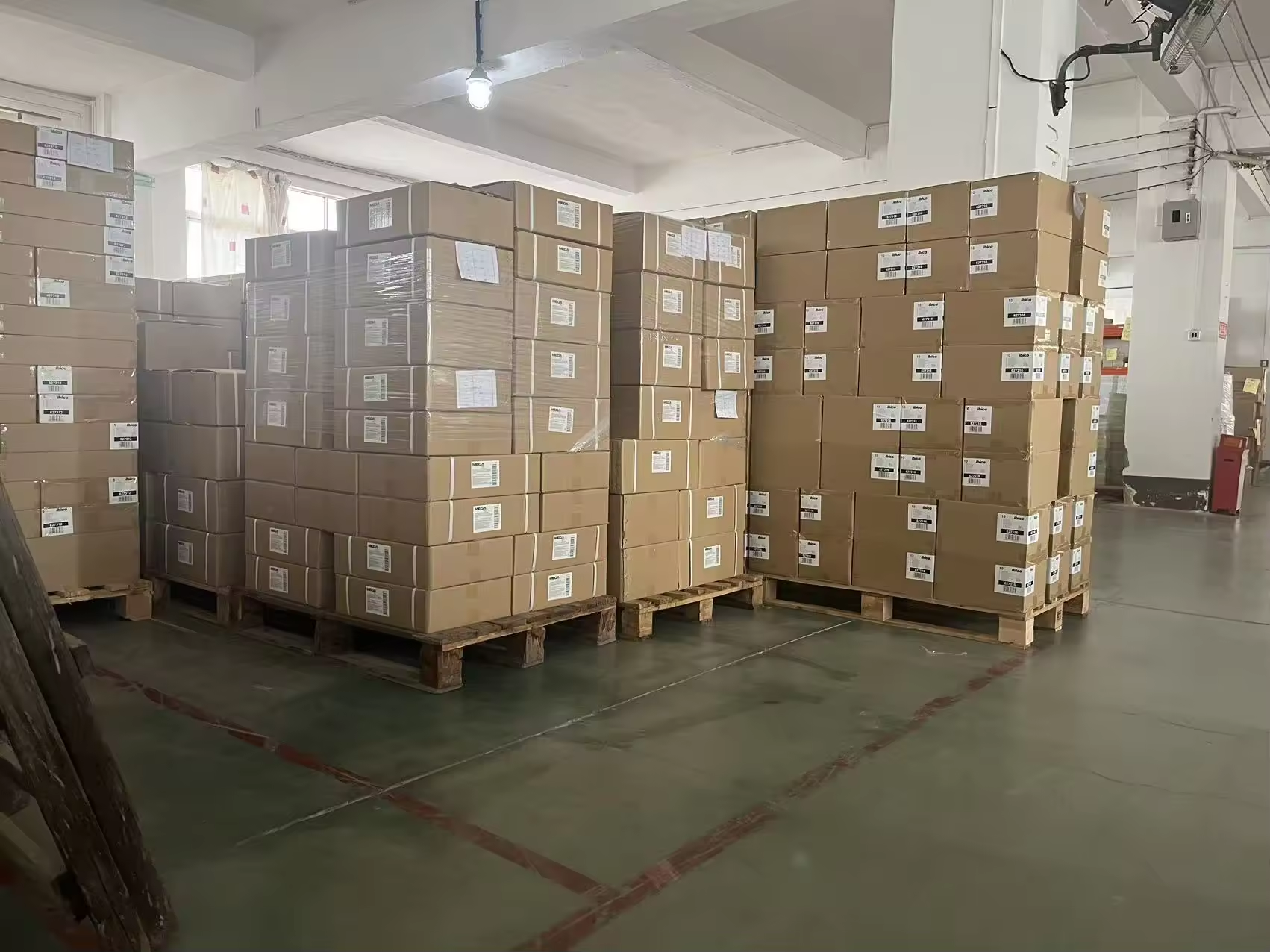
Finished goods stocking and palletizing. Repeat education and retail programmes depend on consistent packing format more than on peak capacity.
For channel proof, consider a brand importer and distributor supplying Germany, Austria and the United States. The programme has run for more than 10 years at 600,000 packs of lamination film per year for office document lamination and stationery protection, with zero quality complaints over that period and a 25% reduction in the customer's lamination failure rate. The programme is pack-format rather than roll-format, but it exercises the same stationery-channel dynamics: private label, repeat orders, and a failure rate that has to fall rather than fluctuate. Customized anti-counterfeiting coating technology and 24/7 technical support for lamination process optimization were part of that cooperation.
Step-by-Step: Specifying a Roll for a School or Retail Project
The sequence below is written so that a procurement officer, a print shop manager or a distributor can run it without a film specialist on the call.
- Classify the item by handling intensity. Daily-handled items (book covers, ID cards, menus), staff-handled items (shelf labels, price tags, replacement signage) and static display items (posters, window graphics) fail for different reasons. The class determines which protection claims go into the specification at all.
- Write the failure list before the specification. Describe the failure in the project's own words: the cover edge lifts after one term; the menu absorbs cleaning liquid; the poster drifts yellow in a south-facing window; the label scuffs in the trolley. Each sentence becomes a verifiable line item rather than a preference.
- Choose the finish against the reading condition. Select glossy where colour and contrast dominate; select matte where glare or constant handling dominates. Approve a laminated proof under the lighting the item will actually live in, because a proof approved on a desk lamp can look different in a shop window.
- Set thickness against rigidity and machine capability. HD-RL is supplied from 35 micron to 250 micron. Lighter gauges suit flexible paper items that must still fold or drape; heavier gauges suit menus, tags and cards where stiffness is the point. The chosen gauge must also sit inside the rated range of the laminator in use, so check the machine before confirming the roll.
- Set width and roll length to the machine and the trim. Width is available from 100 mm to 1,300 mm, and roll length is customizable. A classroom laminator and a production label line need very different widths, and an unnecessary wide roll is simply trimmed waste. Where a distributor serves both, split the specification into two SKUs rather than compromising on one.
- Confirm the environment-specific claims in writing. Water resistance, scratch resistance and anti-yellowing are stated HD-RL features; anti-static grade, UV-protective grade and food-contact suitability are not — those must be requested, quoted and confirmed in writing before the order, not assumed from a general product description.
- Run a trial roll and define acceptance criteria. Laminate the real substrate at the real speed, then inspect for bubbles, wrinkles, curl, edge trim quality, adhesion after cooling, and colour shift. HADA performs 100% inspection before shipment, and acceptance can additionally be structured around pre-shipment inspection by SGS or Intertek, AQL sampling, or customer on-site inspection.
- Lock commercial terms and continuity. Standard film carries a minimum order of 1,000 packs; customized size carries 2,000 pcs or 100 rolls. Delivery terms are FOB Guangzhou or Shenzhen, CIF destination port, or EXW Guangzhou, with payment by T/T (30% deposit, 70% before shipment), L/C at sight, or OA 30 days after shipment. Typical production lead time is 20 to 30 days, against a monthly capacity of 150,000 packs at 100 pcs per pack.
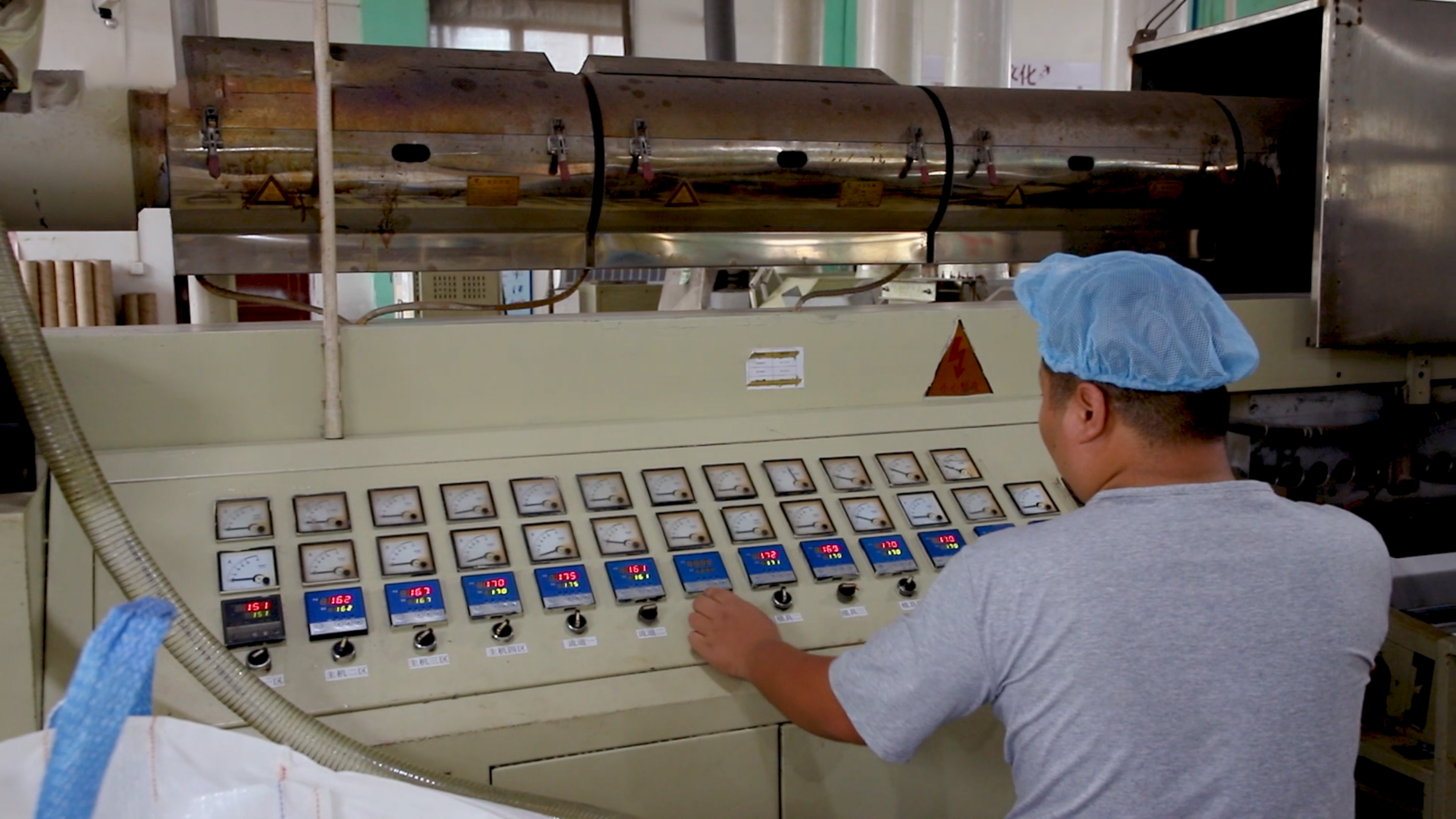
Trial running on the laminator is the only reliable test of bubbles, wrinkles and tension at a project's own operating speed.
After-sales terms belong in the same specification document. HADA provides a 12-month warranty against delamination, color fading and material defects, a 24-hour response time for quality complaints with a dedicated account manager, and free replacement or full refund for non-conforming goods, with priority re-production for bulk orders. For a school district or a chain, those four clauses decide what happens when a single pallet underperforms mid-term.
Application Scenarios: Book Covers, Menus, Labels and Signage
School book covers and exercise books
The dominant risk is edge delamination under daily flexing, followed by water from drink bottles and rain. Specify strong adhesion and waterproof performance, choose a gauge stiff enough to protect a softcover without making the book difficult to open, and test the trimmed edge specifically — a fold-and-rub check on a finished cover tells more than a flat sample ever will.
Library jackets, spine labels and barcode tags
Library items combine handling with long shelf life, and spine labels are read by machines as well as people. High transparency matters here because it preserves barcode contrast, while anti-yellowing supports the multi-year life of a jacket. Matte finishes are often preferred on jackets that are handled at the shelf.
ID cards, badges and membership cards
Cards sit in the ID card and badge application category, where the laminated surface is handled, pocketed and occasionally wiped. Scratch resistance and adhesion do the work; card thickness should be matched to the pouch or roll format the issuing office already uses so the card still fits existing holders and printers.
Canteen menus, table cards and counter signage
This is the most cleaning-intensive application in the guide. Waterproof and scratch-resistant performance is the baseline, and matte finish usually wins because it controls glare under service lighting. Where the laminated item may contact food directly, confirm compliance with Commission Regulation (EU) No 10/2011 in writing — an SGS RoHS report and a REACH/SVHC report do not by themselves establish food-contact compliance.
Retail shelf labels, price tags and promotional posters
Price tags are replaced frequently, so film cost per label and clean trimming matter more than maximum durability. Posters and window graphics invert that logic: they stay in place for months, so anti-yellowing and colour fidelity dominate. Running both from the same supplier is practical because the HD-RL range covers 100 mm to 1,300 mm in width and both finishes, letting a store group standardize on one film family across label and signage work.
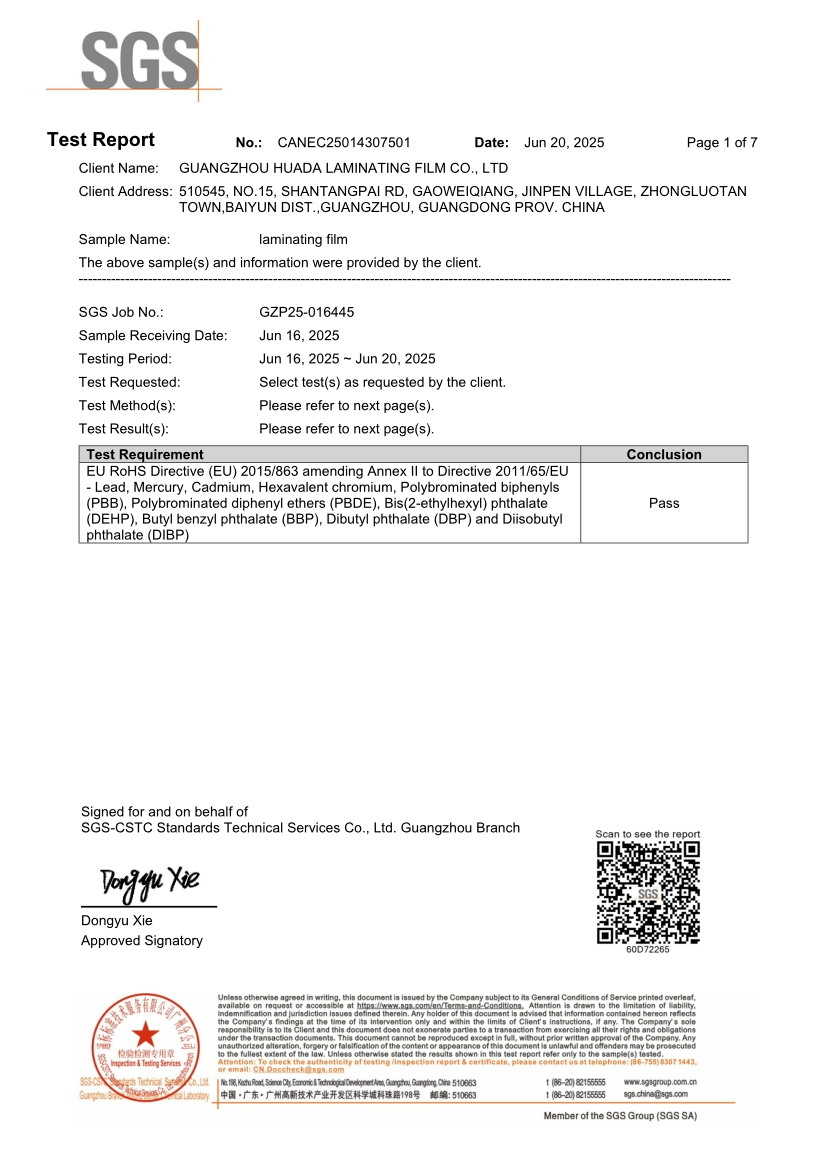
SGS RoHS test report No. CANEC25014307501, issued 20 June 2025, is one of the compliance documents education and retail buyers typically request at tender stage.
Comparison Table: Requirement, Specification and Verification
The table below maps the requirements that recur in education and retail projects to the specification to lock, HADA's documented position on each, and the step a buyer should take before signing. It does not rank suppliers; it separates what is documented from what still needs a written answer.
| Project requirement | Specification to lock | HD-RL documented position | Buyer verification step |
|---|---|---|---|
| Wipe-clean surfaces for menus, table cards and shelf labels | Water resistance of the laminated surface | Waterproof and scratch-resistant listed among product features | Wipe test on a finished, trimmed sample using the site's actual cleaning agent |
| Long display life for posters and window graphics | Resistance to yellowing under daylight | Anti-yellowing for long-term preservation listed among product features | Age a laminated proof beside a reference print and compare neutrality over the project cycle |
| Repeated handling of book covers, cards and badges | Adhesion and trimmed-edge integrity | Strong adhesion listed; suitable for all standard thermal laminators | Fold-and-rub test on the trimmed edge after cooling |
| Thin-film feeding on high-speed or dry-environment lines | Static control | Not stated in the published HD-RL specification | Request a written anti-static or static-dissipative grade with surface resistivity value |
| Colour and readability for signage and photo work | Finish and clarity | Glossy and matte finishes; high transparency | Approve a proof under the intended lighting condition |
| Fit to the existing laminator and trim | Thickness, width and roll length | 35 to 250 micron; 100 to 1,300 mm width; length customizable | Check laminator rating, then order a trial roll at the specified width |
| Food-adjacent use such as canteen menus | Food-contact compliance | SGS RoHS report No. CANEC25014307501; SGS REACH/SVHC report No. CANEC25014307503; SGS PET SVHC report No. CANEC25014307505; ISO 9001:2015 certificate 127878 valid to 26 June 2027 | Confirm whether EU 10/2011 compliance is required and obtain written confirmation |
| Volume, repeatability and delivery certainty | Quality control and lead time | 100% inspection before shipment; 20 to 30 days lead time; 150,000 packs monthly capacity | Pre-shipment inspection (SGS or Intertek), AQL sampling, or on-site inspection |
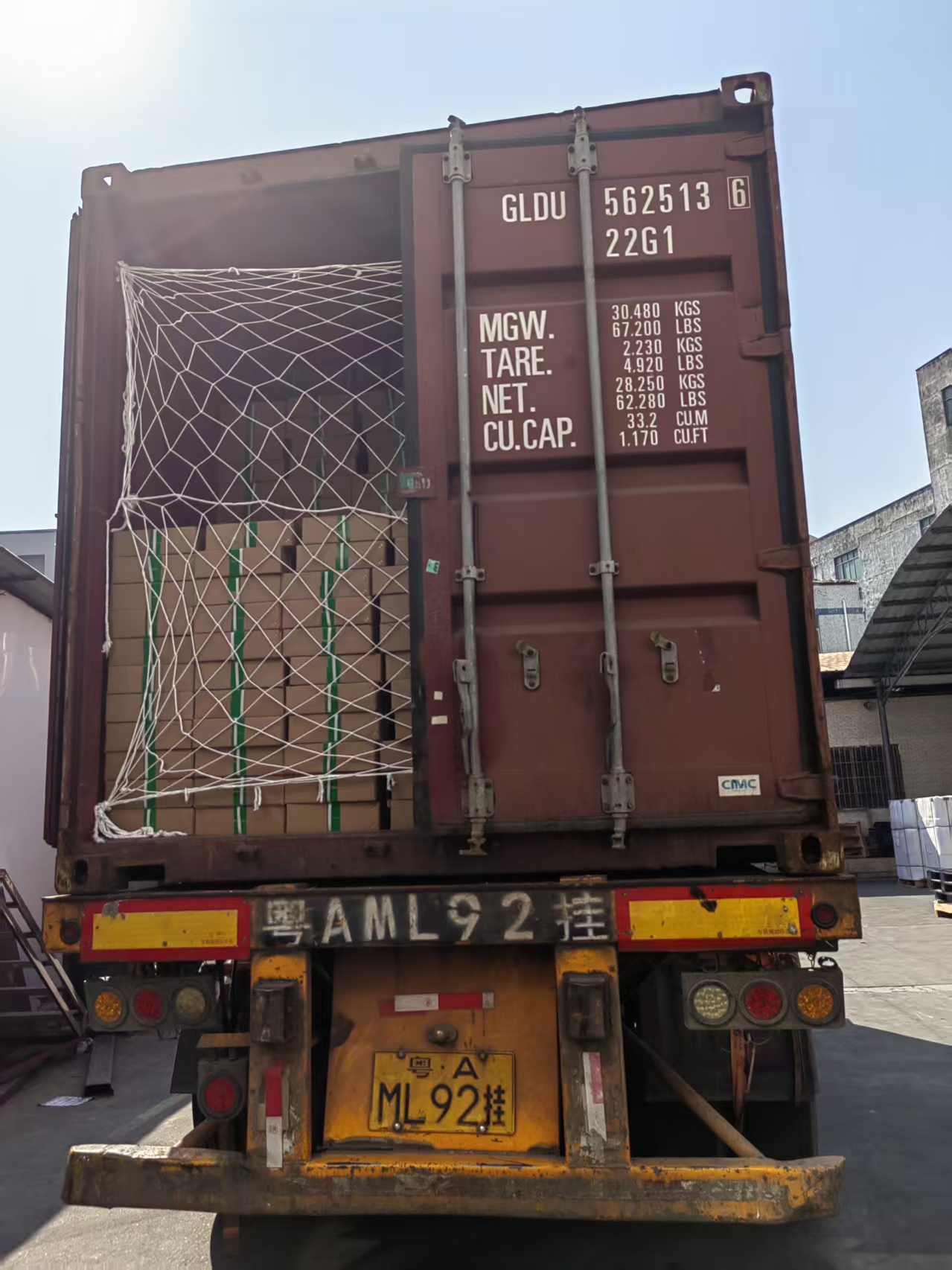
Container loading at HADA. Repeat school and retail programmes are scheduled against a 20 to 30 day production lead time and a 150,000 pack monthly capacity.
Frequently Asked Questions
1. Which compliance documents should a school or retail buyer request for laminating rolls?
HADA holds an SGS RoHS test report (No. CANEC25014307501, issued 20 June 2025), an SGS REACH/SVHC test report (No. CANEC25014307503), and an SGS SVHC screening report for PET film (No. CANEC25014307505), alongside ISO 9001:2015 certification (certificate 127878, valid to 26 June 2027). Buyers should separately confirm whether the project requires food-contact compliance, since plastic materials intended for food contact in the EU fall under Commission Regulation (EU) No 10/2011 — RoHS and REACH reports do not establish food-contact compliance on their own.
2. Can laminating rolls be customized to our laminator width, thickness and private label?
Yes. HADA provides OEM/ODM production with customization of product size, thickness, logo and packaging. The HD-RL thermal laminating roll is produced in PET+EVA from 35 to 250 micron and 100 to 1,300 mm width, with customizable roll length, glossy or matte finish, and customizable packaging. Monthly production capacity is 150,000 packs at 100 pcs per pack, which is the basis for quoting repeat school or retail programmes.
3. What is the minimum order quantity and how are orders priced and paid?
The minimum order is 1,000 packs for standard lamination film, and 2,000 pcs or 100 rolls for customized sizes. Delivery terms are FOB Guangzhou or Shenzhen, CIF destination port, or EXW Guangzhou. Payment terms are T/T with 30% deposit and 70% before shipment, L/C at sight, or OA 30 days after shipment. Because the specification drives roll width, gauge and packing format, the quotation should be requested against a written specification rather than a product name alone.
4. How should a buyer validate a roll before placing a full order?
Run a trial roll on the actual laminator at the actual operating speed, then check for bubbles, wrinkles, curl, trimmed-edge quality, adhesion after cooling, and colour shift against an approved proof. Acceptance can be structured around pre-shipment inspection by SGS or Intertek, AQL sampling, or customer on-site inspection, and HADA performs 100% inspection before shipment as standard. Where anti-static or UV-protective behaviour is required, the trial should include a written specification of that property, since neither is stated in the published HD-RL specification.
5. What lead time and after-sales support apply to repeat education or retail orders?
Typical production lead time is 20 to 30 days. After-sales support includes a 12-month warranty against delamination, color fading and material defects, a 24-hour response time for quality complaints with a dedicated account manager, and free replacement or full refund for non-conforming goods, with priority re-production for bulk orders. To start a sample or quotation request for a book-cover, menu or label programme, contact brian@huada168.com or WhatsApp +86 189 2958 9411, or review the product range at www.huada168.com.
Conclusion: Match the Roll to the Handling, Then Prove It
Education and retail projects reward a boring, disciplined specification. Identify how the item is handled, translate that into the two or three claims that matter — water and scratch resistance for wiped surfaces, adhesion and edge integrity for trimmed items, anti-yellowing for anything that stays on display — then fit thickness, width and finish to the machine and the trim. Anything outside the published HD-RL features, such as anti-static grade, UV protection or food-contact compliance, belongs in a written request rather than an assumption.
HADA's position in this segment rests on 33 years of laminating film manufacturing since 1992, a 40,000 square metre facility in Guangzhou, three automated production lines and an annual capacity exceeding 10,000 tons, with 100% inspection before shipment and a 12-month warranty against delamination, colour fading and material defects. For buyers running school, library or retail programmes, the practical next step is the same one this guide keeps returning to: take a trial roll on the real substrate, at the real speed, and decide from the finished item.
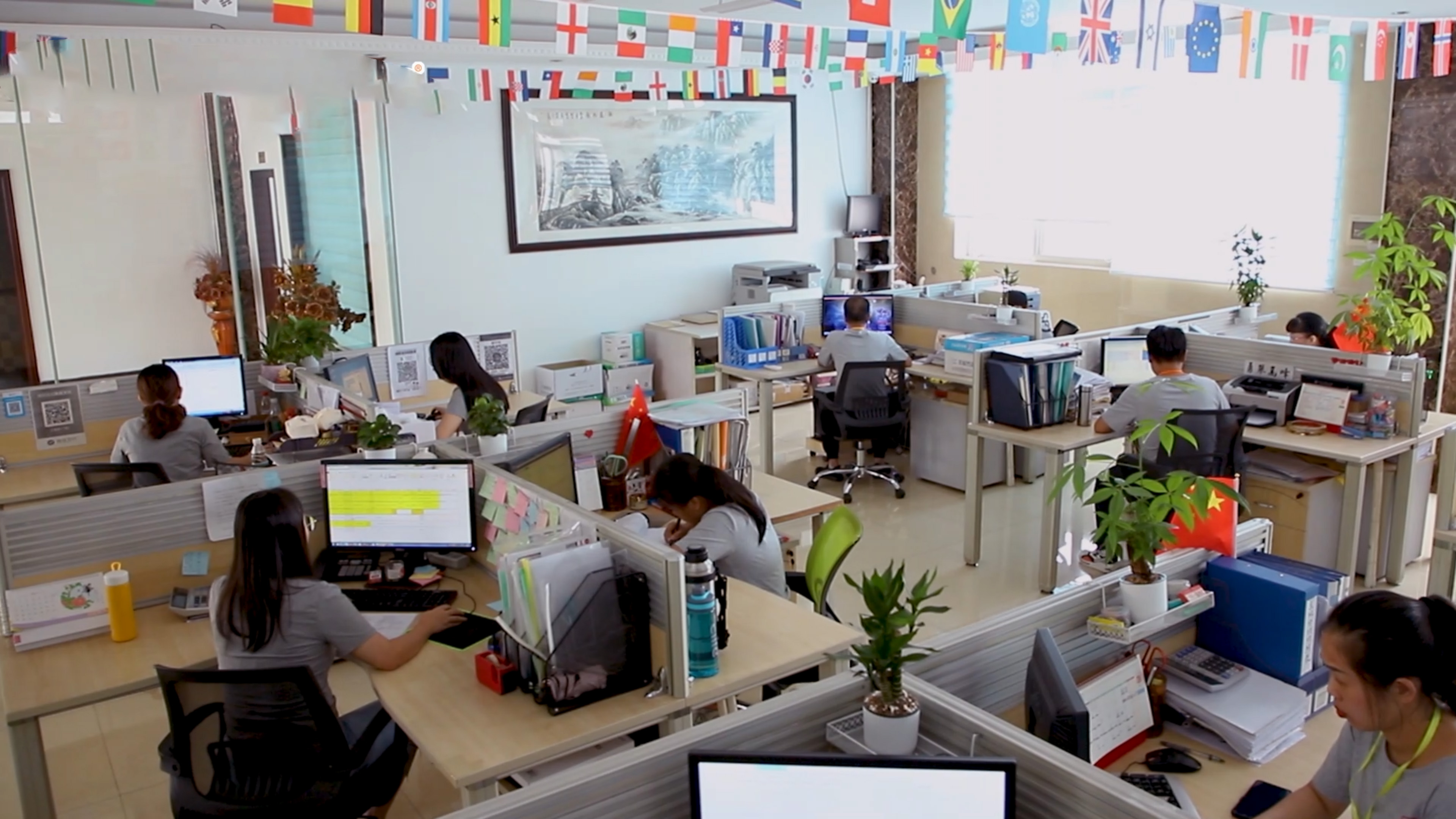
Customization of size, thickness, logo and packaging is handled with the R&D team before a repeat programme is confirmed.
Request a sample roll or a project quotation
Send the item type, the substrate, the laminator's rated thickness and width, and the monthly volume. HADA will confirm the roll specification, packing format and lead time against a written quotation.
Email: brian@huada168.com | WhatsApp: +86 189 2958 9411 | Website: www.huada168.com
Have Questions or Need More Details?
Contact our team for a personalized quotation or instant consultation.
Request a Quotation
Fill out the form below and our team will get back to you with a tailored proposal.
WhatsApp Direct Chat
Prefer to chat in real-time? Message us on WhatsApp for instant assistance & quick answers.
- Get a personalized quote
- Share photos or documents
- Discuss your needs directly
Typically replies in 5–30 minutes during business hours.