How a Laminating Roll Actually Bonds: An Explainer on PET, EVA, and Heat
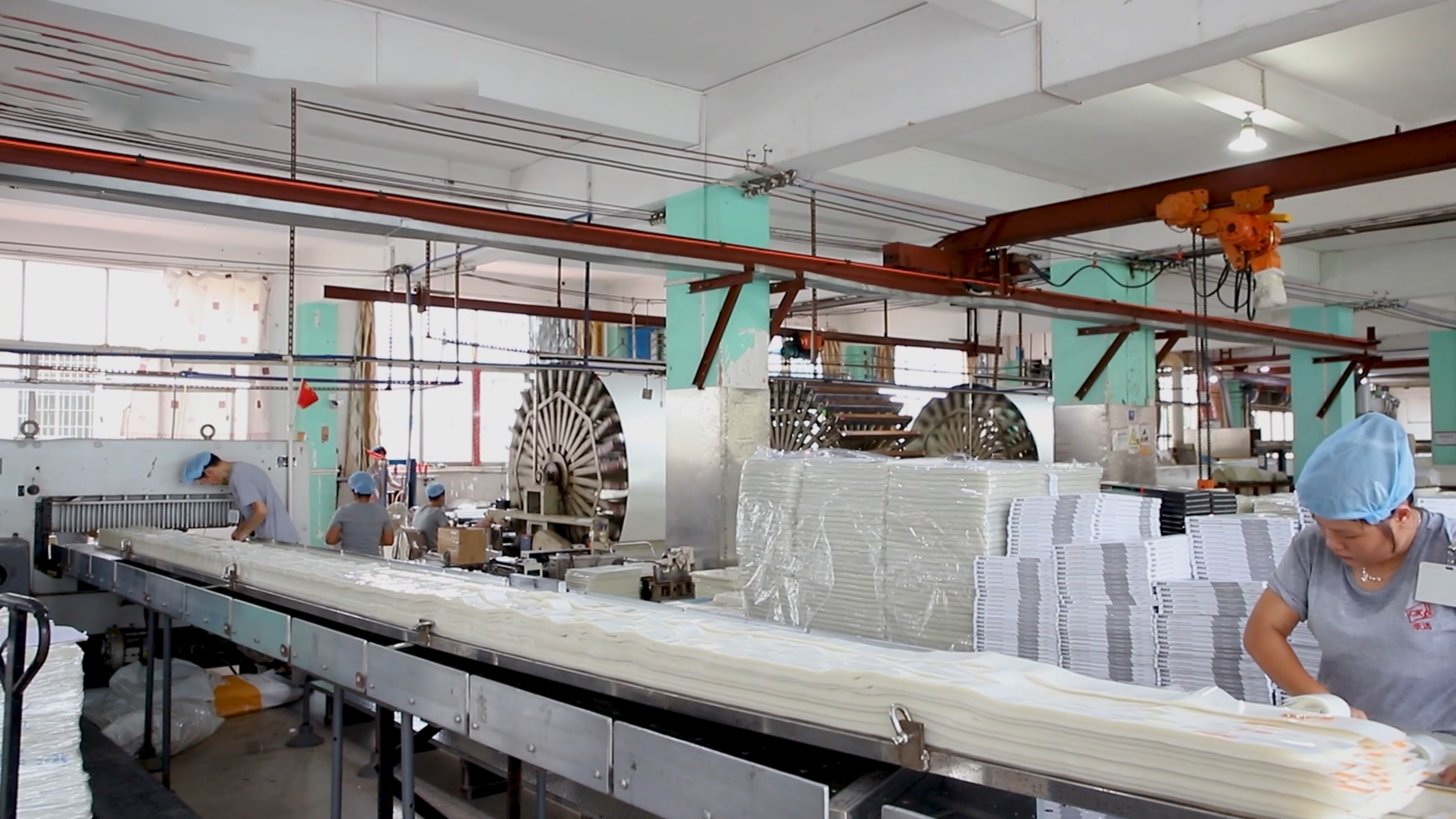
Slitting a jumbo laminating roll film web into finished roll widths. The two-layer PET and EVA construction is already complete at this stage; the roll only becomes adhesive when heat is applied in the laminator.
A laminating roll bonds through a controlled phase change, not through surface stickiness. The roll is a two-layer composite: a polyester carrier film, usually PET, and a thermoplastic adhesive layer, most often EVA. At room temperature the EVA is solid and non-tacky. Inside a roll laminator or a pouch laminator, heat brings the adhesive into its flow window, the nip pressure drives it into the microscopic texture of the printed surface, and cooling re-solidifies it into a permanent bond. Heat, flow, consolidation and cooling are the entire mechanism. Thickness, finish, width and coating choices only change how each of those four stages behaves.
That distinction matters at the evaluation and specification stage, because it explains two things buyers run into constantly: why two rolls with identical micron ratings can behave completely differently on the same machine, and why a roll that performs well on one substrate can fail on another without anything being defective.
Problem definition: most lamination failures are diagnosed in the wrong place
When a bond fails, the first question is usually about the adhesive — is the glue weak? In practice the adhesive formulation is rarely the variable that changed. Each stage of bond formation has its own failure signature, and reading the symptom correctly shortens troubleshooting considerably.
- Cloudy, milky or frosted result. The adhesive never reached its flow window, so it could not wet out the substrate. The interface is filled with micro-voids that scatter light instead of transmitting it.
- Bubbles concentrated at the entry edge or in patches. Insufficient nip pressure, or trapped air the melt was too viscous to displace.
- Edge curl and sheet curl. Asymmetric cooling, or sheets stacked before the bond had stabilised.
- Delamination weeks or months later. Usually a wetting failure that passed initial inspection, or a substrate releasing plasticiser into the interface over time.
- Yellowing over service life. Rarely the adhesive alone; a combined effect of carrier film chemistry, coating system and light exposure.
Read this way, a laminating roll is not a consumable with a fixed quality level. It is a process input, and the specification that matters is the one matched to the machine, the substrate and the finishing conditions.
Industry background: why PET and EVA keep appearing together
Thermal lamination films are a substantial and still-expanding segment. Fact.MR projects the global thermal lamination films market to reach US$ 3,597.8 million by 2035. Within the thermal laminating machine film market, BOPP-based films held a 36% share in 2024, PET 28% and nylon 18%, according to commercial research published by Vertex. BOPP's lead reflects high-volume packaging work where a thinner structure is acceptable; PET's share reflects applications where dimensional stability and optical clarity carry more weight.
The material architecture is consistent across the category. The PRINTING United Alliance describes laminating supplies as generally polyester-based with a co-extruded copolymer adhesive. Supplier technical pages repeat the same pattern: one states that its PET thermal lamination film uses a PET base film with an extruded EVA adhesive layer, while another lists BOPP, BOPET and BOPA base films with EVA coating in glossy and matte finishes. The base polymer varies by application. The EVA adhesive layer is the near-constant.
The reason is functional rather than conventional. PET contributes stiffness, dimensional stability under heat and a high-clarity surface that does not deform in the nip. EVA contributes a relatively low softening range, flexibility, and adhesion across a broad set of inks, papers and boards. Combined, the pair produces a film that stays mechanically stable while the adhesive is fluid — which is exactly what a continuous lamination line needs.
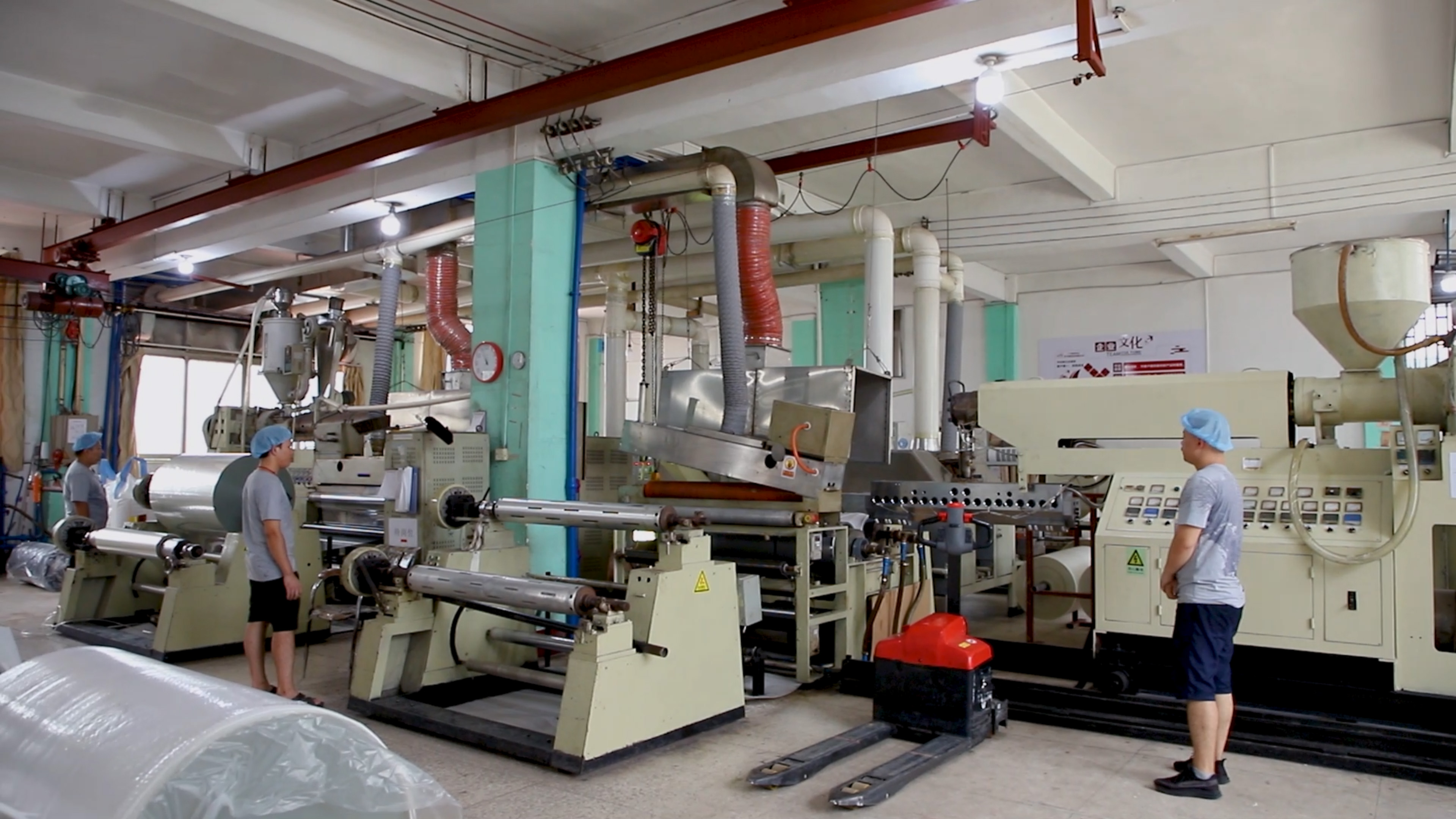
Coating and drying stage on an automated laminating film line. The adhesive layer is applied as a controlled thickness so that the finished roll has a predictable flow window.
How the bond forms, stage by stage
Stage 1 — Heat transfer into the adhesive
Heat enters through the carrier film. Because PET is the layer in contact with the heated roller, its thermal behaviour sets the pace: the adhesive cannot reach its flow window faster than heat can pass through the base film. That is why roller temperature on its own is a misleading setting. What matters is the temperature actually reached at the adhesive interface, and that depends on dwell time, roller mass, base film thickness and the starting temperature of the sheet.
Stage 2 — The flow window
EVA does not have a sharp melting point; it softens across a range determined by its vinyl acetate content and melt index. Below that range, viscosity is too high for the adhesive to wet the substrate. Above it, viscosity falls so far that the film can squeeze out at the edges, while the substrate absorbs heat it was never designed for — thermal paper darkens, some inks shift, thin stocks cockle and cockle permanently.
This is the practical meaning of a low-melt laminating roll: the adhesive grade is formulated to reach usable flow at a lower interface temperature. The benefit is not energy saving alone. A lower activation ceiling widens the process window for heat-sensitive substrates and reduces the thermal shock that produces curl and dimensional change in thin papers and boards.
Activation temperature is a property of the adhesive grade, not a setting that travels with the machine. Two rolls of identical thickness can require noticeably different roller settings, which is why the supplier's technical data — not a generic temperature table copied from a forum — should be the starting point for any new roll qualification.
Stage 3 — Wetting and displacement under nip pressure
Pressure does three jobs at once. It brings the melted adhesive into intimate contact with the substrate, which is what wetting actually means. It displaces the air film that would otherwise become a bubble. And it sets the final adhesive thickness, which controls how the finished sheet looks and how it handles.
Nip pressure, roller hardness and the contact arc together determine how long the melt is held under load — the dwell time. Line speed changes dwell time directly: doubling speed halves the time available both for heat transfer and for flow. This is why a roll that performs correctly at one line speed can look under-bonded at another, with no change to the film itself.
Stage 4 — Cooling and consolidation
Strength appears on the cooling side. As the EVA solidifies it contracts slightly and its crystallinity develops; the bond reaches working strength only after the film has dropped below the softening range. Pulling a warm sheet through tension rollers, or stacking warm sheets, sets stresses into the composite that reappear as curl days later. Controlled cooling under maintained tension is what produces a flat finished sheet, and it is the stage most often compressed when a line is pushed for throughput.
Why a thermal roll stays non-tacky at room temperature
A thermal laminating roll is designed to be stable in storage. At room temperature and normal pressure the EVA layer is solid, so a jumbo laminating roll can be wound tightly, palletised and shipped without blocking or interleaving. Bonding begins only when the film enters the machine and the adhesive crosses its activation threshold under nip pressure.
For wholesale laminating rolls and distributor stock, that stability is a logistics property as much as a technical one. A roll that stays non-tacky through a full shipping cycle — container heat, port delays, warehouse temperature swings — arrives usable. Conversely, powdering, edge blocking or partial tack on arrival is a storage and formulation signal, not a shipping accident.
Step-by-step: following one sheet through the machine
- Unwind and tension setting. The roll feeds at controlled tension. Too little tension produces wrinkles that the nip then presses permanently into the sheet; too much stretches the web and distorts registration on printed work.
- Entry into the heated zone. The film starts absorbing heat. At this point the adhesive is still solid and nothing is bonding yet.
- Nip engagement. Film and substrate meet under pressure. This is the only moment when the adhesive can flow into the surface texture, so nip condition and roller cleanliness matter more here than anywhere else on the line.
- Melt flow and air displacement. The adhesive wets out and pushes trapped air ahead of it. Bubbles that survive this stage cannot be removed later, which is why edge bubbles are a pressure symptom rather than a film defect.
- Cooling under tension. The bonded sheet passes over chilled rollers while tension is maintained. Flatness is fixed here.
- Post-nip inspection. Clarity, edge trim and surface defects are visible at this point. Catching a temperature drift here avoids a full ream of rejects.
- Rewind or sheet cutting. Only fully cooled stock should be cut, stacked or packed. Cutting warm material is one of the most common causes of curl reported as a film fault.
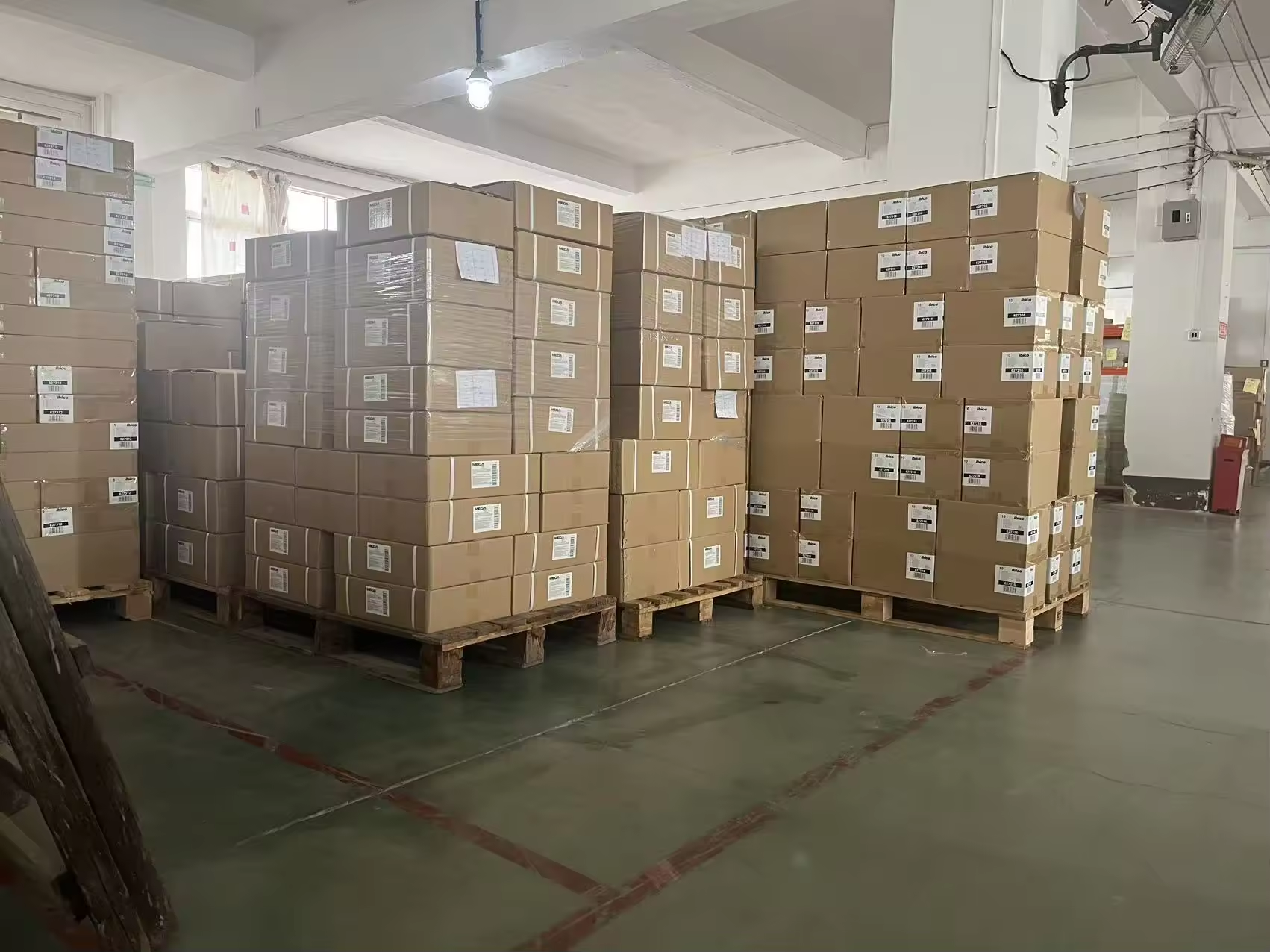
Finished goods stocking and palletising. Thermal laminating rolls remain non-tacky at room temperature, so wound rolls can be stacked and shipped without blocking.
What the coatings contribute after the bond has formed
Adhesion is only one function of a laminating roll. Functional coatings decide how the finished surface behaves in service, and on a technical data sheet they normally appear as separate specification lines.
- Anti-static treatment reduces surface charge so sheets do not attract dust, cling to each other or discharge in dry production environments. It matters most on high-speed converting lines and where laminated material sits next to electronics packaging.
- Anti-yellowing and UV-protective systems slow the photo-oxidation that turns clear film amber over years of light exposure. The claim is only meaningful when the supplier can describe the test method behind it.
- Anti-scratch top layers raise surface hardness so laminated covers, cards and shelf-facing print survive handling and abrasion.
This is where a careful buyer separates chemistry from marketing language. A performance percentage quoted without a test method, a reference sample and a measurement condition cannot be compared across suppliers — the numbers describe different tests. Ask instead for four things: the property measured, the standard or in-house method used, the reference it was measured against, and the age of the sample at testing. A supplier who can answer those questions is describing a product. A supplier who cannot is describing an impression.
Comparison table: base film options in thermal laminating rolls
| Base film | 2024 share of thermal film market | What it contributes to the bond | Where it is commonly specified | What to verify before ordering |
|---|---|---|---|---|
| PET / BOPET (polyester) | 28% | Dimensional stability under heat, stiffness, high clarity; survives the nip without deforming | Document lamination, book covers, cartons and labels where optical quality is judged closely | Base film gauge, adhesive grade and activation range, finish consistency across the roll |
| BOPP (polypropylene) | 36% | Thinner structure, suits high-speed packaging lines; paired with an EVA coating for thermal activation | High-volume packaging lamination where a lighter film is acceptable | Heat stability at line speed, curl behaviour on thin stock, finish uniformity |
| BOPA / nylon | 18% | Toughness and puncture resistance; used with EVA coating in thermal lamination film constructions | Applications where mechanical durability outranks optical clarity | Dimensional behaviour under heat, adhesion to the specific substrate |
Market share figures refer to 2024 and to the thermal laminating machine film market as reported by Vertex commercial research; total exceeds 100% because the remainder is distributed across other film types. The material descriptions reflect supplier-published constructions for PET + EVA and for BOPP, BOPET and BOPA base films with EVA coating.
Comparison table: thermal versus cold roll lamination
| Parameter | Thermal laminating roll | Cold laminating roll |
|---|---|---|
| Bonding mechanism | Heat-activated EVA adhesive that flows in the nip and solidifies on cooling | Pressure-sensitive adhesive applied at ambient temperature under nip pressure |
| Equipment requirement | Heated rollers with controlled temperature and nip pressure | Pressure rollers; no heat input required |
| Heat-sensitive substrates | Requires an adhesive grade with an activation range the substrate can tolerate | Suitable where heat would damage the substrate |
| Bond development | Strength develops after cooling; flatness fixed by controlled cooling under tension | Strength develops as pressure is applied; no thermal cooling cycle |
| Typical evaluation question | Does the activation window match the machine, line speed and substrate? | Does the adhesive achieve the required peel strength on the specific surface? |
Both film types are supplied in roll format and both appear in manufacturer portfolios; capacity for the two is normally reported separately because the processes and equipment differ. The choice between them is a substrate and equipment decision before it is a cost decision.
Use cases where the PET and EVA bond is tested hardest
Office document lamination and stationery protection
This is the most demanding environment for consistency rather than peak performance: many machines, many operators, frequent stops and starts. A brand importer and distributor supplying office document lamination and stationery protection across Germany, Austria and the United States has used this product for over 10 years of continuous cooperation, at 600,000 packs of lamination film per year, distributed wholesale under the client's own brand. The reported outcome is zero quality complaints across 10 years and a 25% reduction in the customer's lamination failure rate, supported by customized anti-counterfeiting coating technology and 24/7 technical support for lamination process optimization.
Packaging and printing
Folding cartons, book covers and labels combine high line speeds with demanding visual standards. Here the practical question is whether the adhesive wet-out keeps pace with throughput, and whether gloss or matte finish stays uniform from the first metre of a roll to the last. Glossy laminating rolls maximise colour depth; matte laminating rolls suppress reflection and hide scuffing. Both depend on the same underlying bond.
Food-contact packaging
Where laminated film touches food, bonding is no longer the only qualification. Regulation (EU) No 10/2011 sets migration limits for plastic materials intended for food contact, and compliance has to be demonstrated for the specific construction rather than assumed from the base polymer. Buyers should request migration test documentation for the exact grade and thickness being purchased, alongside the standard RoHS and REACH documentation.
Distribution and private label
Distributors and own-brand programmes add a second layer of risk: the roll has to perform on machines the supplier never sees, in climates it never tested, for customers who will blame the brand rather than the film. That makes documentation, batch consistency and after-sales response part of the product specification.

R&D engineering at Guangzhou Huada Laminating Film Co., Ltd. (HADA), which holds 22 national patents across functional laminating films.
Where the rolls come from: HADA's manufacturing base
Guangzhou Huada Laminating Film Co., Ltd. (HADA) is a laminating film manufacturer founded in 1992 and based in Guangzhou, China, with over 33 years in the laminating film industry. The company operates a 40,000 m² facility with 200 employees, a five-engineer R&D team and three automated production lines, with annual capacity exceeding 10,000 tons and exports to more than 50 countries and regions across North America, South America, Europe, Australia and Southeast Asia.
Product capability covers OEM/ODM production with customization of product size, thickness, logo and packaging, a monthly capacity of 150,000 packs at 100 pieces per pack, and a typical production lead time of 20–30 days. Quality control includes 100% inspection before shipment, with acceptance procedures covering pre-shipment inspection by SGS or Intertek, AQL sampling and customer on-site inspection. After-sales support includes a 12-month warranty against delamination, colour fading and material defects, a 24-hour response time for quality complaints with a dedicated account manager, and free replacement or full refund for non-conforming goods. Certifications include ISO 9001, BSCI, SMETA, RoHS and REACH, and the product range covers glossy, matte, cold lamination and PET film families.
FAQ
1. What compliance documentation should accompany a PET and EVA laminating roll?
Request the certificate or report for each claim, not a summary line on a brochure. HADA holds ISO 9001:2015 Quality Management System certification (certificate 127878, issued through CNCA, valid to 26 June 2027). RoHS, REACH and SVHC documentation for the laminating film is issued by SGS-CSTC Standards Technical Services Co. Ltd. — RoHS report No. CANEC25014307501 (20 June 2025), REACH report No. CANEC25014307503 (23 June 2025) and the PET plastic film SVHC screening test report No. CANEC25014307505 (20 June 2025). For food-contact applications, RoHS and REACH are not sufficient on their own: Regulation (EU) No 10/2011 sets migration limits for plastic materials intended for food contact, so ask for migration testing on the exact grade and thickness you intend to buy.
2. Can the adhesive, thickness and roll dimensions be customized for a specific laminator?
Yes, within the manufacturer's production capability. HADA provides OEM/ODM production services with customization options covering product size, thickness, logo and packaging, backed by three automated production lines, a five-engineer R&D team and 22 national patents across functional laminating films. Because activation temperature is a property of the adhesive grade, the useful starting point for customization is not a thickness figure alone but a short machine profile: laminator type, roller temperature range, line speed, substrate and target finish. That information is what allows the adhesive and coating specification to be matched rather than guessed.
3. What order volumes and payment terms apply?
The minimum order quantity is 1,000 packs for standard lamination film and 2,000 packs or 100 rolls for customized sizes. Delivery terms are FOB Guangzhou or Shenzhen, CIF destination port, or EXW Guangzhou. Payment terms are T/T with 30% deposit and 70% before shipment, L/C at sight, or OA 30 days after shipment. Monthly production capacity is 150,000 packs at 100 pieces per pack, which sets the practical ceiling on how quickly a large private-label programme can be scheduled.
4. Can we validate a roll on our own equipment before committing to a production order?
That is the recommended sequence, because the bond only proves itself on the substrate and machine it will actually run on. Send the machine profile — laminator type, roller temperature range, line speed, substrate grade and required finish — together with the target thickness and width, and evaluate trial material against three checks: clarity after cooling, edge and centre adhesion after a 24-hour settle, and curl behaviour after stacking. Pre-shipment inspection by SGS or Intertek, AQL sampling and customer on-site inspection are all available as acceptance routes on the production order that follows.
5. What lead time should we plan for?
Typical production lead time is 20–30 days, after which transit time depends on destination and shipping method. Every order is inspected 100% before shipment, and the 12-month warranty covers delamination, colour fading and material defects, with a 24-hour response time for quality complaints and a dedicated account manager. To start a sample or quotation request, contact HADA through www.huada168.com or email brian@huada168.com with your machine profile and target specification.
Conclusion: the bond is a process, and the roll is one variable in it
A laminating roll bonds because a thermoplastic adhesive is brought into its flow window, pressed into the substrate while it is fluid, and allowed to solidify under controlled tension. PET provides the stable carrier that makes that sequence repeatable at speed; EVA provides the activation behaviour that makes it achievable at a temperature the substrate can survive. Everything a buyer evaluates — thickness in microns, gloss or matte, jumbo or custom-width format, anti-static or UV-protective treatment — is a modifier on one of those four stages.
That is also the practical conclusion for specification work. When a roll underperforms, the productive question is not whether the adhesive is good, but which stage drifted: heat transfer, flow window, nip pressure or cooling. Once the question is framed that way, a technical data sheet becomes readable, a supplier conversation becomes specific, and two rolls that looked identical on paper stop being treated as interchangeable.
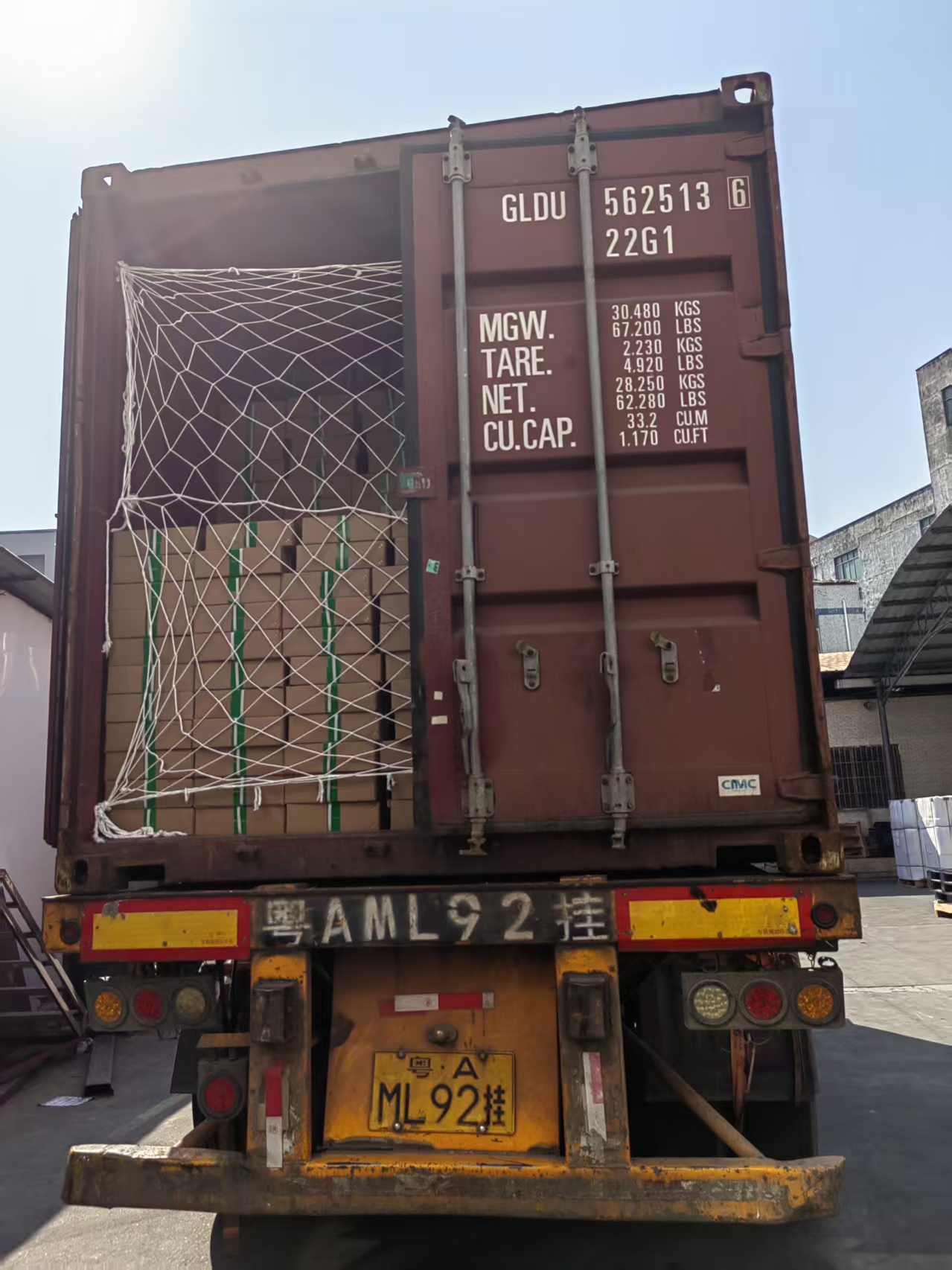
Container loading for export. HADA ships laminating rolls to more than 50 countries and regions, with 80% of output exported.
Specify the bond, not just the micron
Send HADA your laminator type, roller temperature range, line speed, substrate and target finish. The engineering team will match the adhesive grade, base film and roll dimensions to your process, and arrange trial material before a production order.
Website: www.huada168.com | Email: brian@huada168.com | WhatsApp: +8618929589411
Guangzhou Huada Laminating Film Co., Ltd. — No.15, Shantangpai Road, Gaoweiqiang, Jinpen Village, Zhongluotan Town, Baiyun District, Guangzhou, Guangdong Province, China.
Have Questions or Need More Details?
Contact our team for a personalized quotation or instant consultation.
Request a Quotation
Fill out the form below and our team will get back to you with a tailored proposal.
WhatsApp Direct Chat
Prefer to chat in real-time? Message us on WhatsApp for instant assistance & quick answers.
- Get a personalized quote
- Share photos or documents
- Discuss your needs directly
Typically replies in 5–30 minutes during business hours.