Micron vs. Mil in Laminating Roll Film: A Plain Explainer
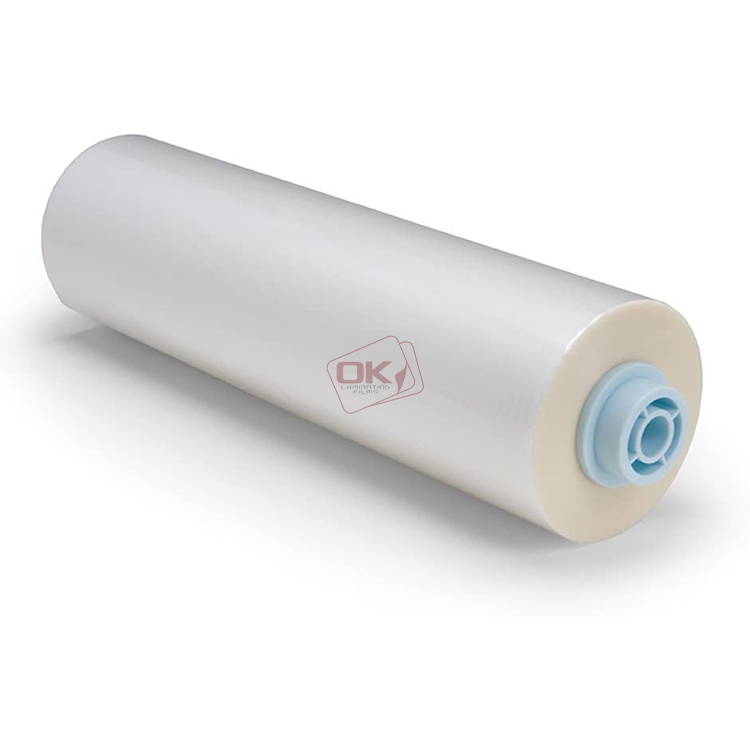
A micron and a mil both measure film thickness, and one mil equals 25.4 microns. That single conversion explains most of the confusion buyers meet when they compare laminating roll film from one supplier with laminating pouches from another. A pouch labelled "3 Mil" and a pouch labelled "75mic" are describing approximately the same gauge in two different measurement systems. Neither label is more precise by default, and neither is a quality claim.
This explainer defines both units, shows where they appear in roll and pouch specifications, and explains why the difference matters in practice for packaging printers and document finishers. It uses HADA's published specifications as reference points, including the HD-RL laminating roll film range of 35mic to 250mic and pouch examples at 80mic, 3Mil/75mic and 5Mil/125mic. HADA — Guangzhou Huada Laminating film Co., Ltd. — is a laminating film manufacturer established in 1992 with more than 33 years in the industry, producing laminating film, laminating pouches and laminating rolls.
What a Micron and a Mil Actually Measure
Both units describe the same physical property: the caliper, or thickness, of the film. Neither says anything about the polymer, the adhesive, the finish, or how the material will behave on a given machine. Thickness is one line in a specification, and it is read correctly only when the unit, the composition and the format are read together.
A micron is one millionth of a metre, written µm and spoken as "micron" or "micrometre". It is a metric unit, and it is the default in most European and Asian film documentation. A mil is one thousandth of an inch, written "mil", and it remains the default in much North American packaging and print documentation. The two words look similar and describe very different amounts: one mil is roughly twenty-five times thicker than one micron.
Two writing hazards follow from that. First, "mil" is not "millimetre" and not "mm"; a 3 mil film is not 3 mm thick. Second, "micron" and "micrometer" name both a unit and a measuring instrument, so a specification sheet using "micrometer" needs its context checked before the number is trusted. Some film documentation also uses "gauge" or "thou", which are separate conventions again. When a supplier uses one of these, ask for the definition restated in the unit you are comparing against rather than assuming a conversion.
Why Packaging and Print Still Run on Two Systems
Laminating film is traded internationally, so the same product family is often documented in metric by some suppliers and in imperial by others. A converter in North America may receive a pouch specification in mil and a roll specification in microns in the same week. A European distributor may be asked by a customer to quote "5 mil" for a product that its factory lists at 125mic.
The unit is not a quality signal and not a regional performance standard. It is a documentation convention inherited from the market a supplier usually sells into. The practical consequence is that thickness comparisons across suppliers are valid only after conversion, and that a purchase order omitting the unit is genuinely ambiguous. A bare "80" on a line item could mean 80 micron, 80 mil or 80 gauge depending on who wrote it.
The Conversion, Worked Out
To convert mil to microns, multiply by 25.4. To convert microns to mil, divide by 25.4. The figures in the table below are calculated from that relationship and rounded for readability; the stated values are the ones that appear in HADA's published product specifications.
| Specification reference | Mil (calculated) | Micron (stated) | Note |
|---|---|---|---|
| HD-RL roll film, low end | ≈1.4 | 35 | Thickness range 35mic–250mic |
| Letter size pouch, 3 Mil | 3 | 75 | Stated as 3Mil/75mic (38/37); exact conversion 76.2 |
| A4 pouch, 80mic | ≈3.1 | 80 | Stated as 80mic (50/30) |
| Letter size pouch, 5 Mil | 5 | 125 | Stated as 5Mil/125mic (75/50); exact conversion 127 |
| HD-RL roll film, high end | ≈9.8 | 250 | Thickness range 35mic–250mic |
Two rows deserve attention. HADA lists the Letter size pouch as 3Mil/75mic and 5Mil/125mic. Multiply 3 by 25.4 and the exact result is 76.2 microns; multiply 5 by 25.4 and the result is 127 microns. The trade pairs 3 Mil with 75mic and 5 Mil with 125mic as convenient round numbers. The gap is small, but it is real, and it is why a buyer should treat "3 mil" and "75 micron" as equivalent trade descriptions rather than exact mathematical identities.
Where the Number Appears in a Real Specification
The printed thickness is usually a total, not a single layer
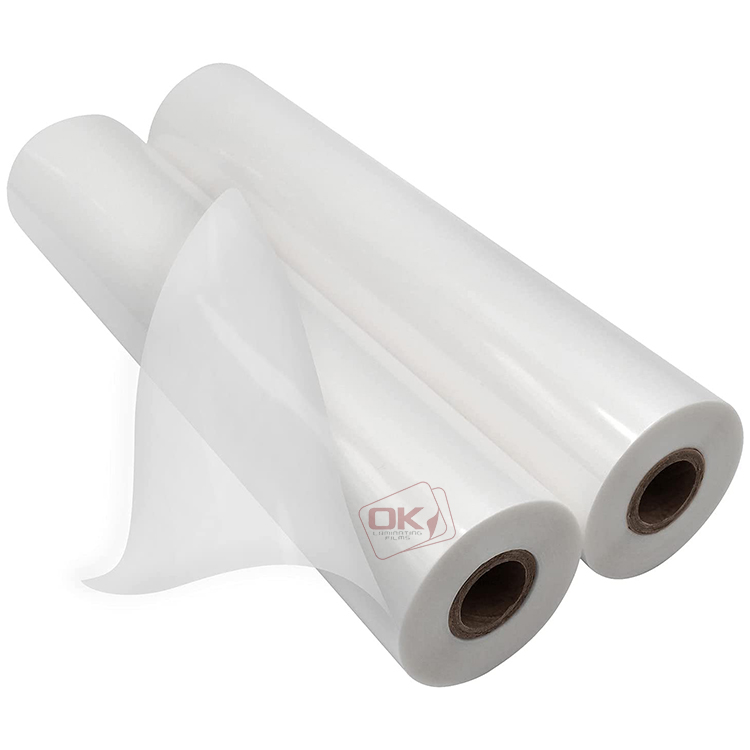
The thickness on a pouch box normally describes the combined film, not the carrier layer alone. HADA's pouch data shows the structure behind the number: the A4 pouch is listed as 80mic (50/30), meaning a 50 micron layer plus a 30 micron layer totalling 80 microns; the Letter size pouch is listed as 3Mil/75mic (38/37) and 5Mil/125mic (75/50).
For a technical buyer, the bracket is often more informative than the headline figure. Two products can both be described as 80 micron and still be built with different layer proportions. The headline number tells you the total gauge; the bracket tells you how that gauge is composed. Both are needed before one specification is genuinely comparable with another supplier's.
Roll film is quoted as a range; pouches are quoted as a fixed value

HADA's HD-RL laminating roll film is specified as PET and EVA, with a thickness range of 35mic to 250mic and a width range of 100mm to 1300mm; length and packaging can be customized. A roll buyer therefore selects a thickness inside a range and pairs it with a width. A pouch buyer chooses from a fixed menu instead: the A4 pouch is 80mic at 216 × 303 mm, and the Letter size pouch is 3 Mil or 5 Mil at 229 × 292 mm (9 × 11.5 in), in glossy or matte finish.
That structural difference matters when two quotations are placed side by side. "75 micron" on a roll quotation and "75 micron" on a pouch quotation describe the same nominal gauge but not the same purchase. The roll has a width and a customized length; the pouch has a cut size and a pack count. Thickness is only the first of several dimensions that must match before the comparison is meaningful.

Step by Step: Reading a Thickness Specification Before You Order
The sequence below is deliberately mechanical. It turns an ambiguous label into a checkable requirement in about the time it takes to read a specification sheet.
- Write the unit out in full. Replace a bare "80" with "80 micron" or "80 mil" before doing anything else. If the source uses gauge, thou or an unqualified number, ask the supplier to restate it in micron or mil.
- Convert both sides to one unit. Pick the unit your own purchasing or quality team works in. Multiply mil by 25.4 or divide micron by 25.4, and record the result as a calculated figure rather than a stated one.
- Separate the total from the layer split. Look for a bracket such as (50/30) or (38/37). If it is missing, ask for the base film and adhesive layer thicknesses, because the total alone does not describe the construction.
- Identify the format. A range such as 35mic–250mic indicates roll film. A discrete value tied to a size, such as 80mic A4, indicates pouches. Do not compare a range midpoint with a fixed pouch value and present the result as a product comparison.
- Check the machine. Roll film runs on roll laminators; pouches run on pouch laminators. The format decision comes before the thickness decision, because a gauge that cannot run on the available equipment is not a usable option.
- Put the converted figure in writing. State the unit, the value and the composition on the RFQ or purchase order, and ask the supplier to confirm it in the same form. A confirmed written figure is the only version that survives a re-quote or a language change.
What This Means in Different Workflows
For packaging printers running continuous production, roll film is the working format and the thickness question arrives as a range decision. HD-RL covers 35mic to 250mic, and the useful discipline is to state the target micron, the tolerance and the roll width together, since the available width range runs from 100mm to 1300mm and a thickness confirmation without a width confirmation is only half a specification.
For document finishers, retail print shops and school or office users, the working format is usually the pouch, and the thickness question arrives as a menu choice between an 80mic A4 pouch and a 3 Mil or 5 Mil Letter pouch. Here the conversion matters mainly at the point of comparison: a customer who asks for "5 mil" and receives a quotation in microns needs the arithmetic done before the two documents can be discussed productively.
The same logic holds across the industries these products serve, from office supplies and education to advertising and graphic production. In every case the order is identical — unit first, composition second, format third, equipment fourth — and it is that order, not the arithmetic alone, that prevents a wrong order.
Common Misreadings and How to Catch Them
Mil read as millimetre. A 3 mil film is roughly 0.076 mm, not 3 mm. The error is rare in professional purchasing but common in informal email threads, and it is worth correcting once at the start of a project rather than at the point of delivery.
Micron read as a measuring instrument. Micrometre names both the unit and the device. When a document says "micrometer", check whether it means µm or a physical gauge reading.
Rounded trade pairs treated as exact. The 3 Mil and 75mic pairing is a commercial convention, not a mathematical identity. A difference of just over one micron is immaterial for most applications, but it should be acknowledged when two suppliers quote in different units.
Thicker assumed to be better. Thickness changes handfeel, stiffness and roll geometry, but the number alone does not establish adhesion, clarity or durability. HADA's film specifications describe high transparency, strong adhesion, waterproof and scratch-resistant properties, and anti-yellowing for long-term preservation as distinct characteristics — none of which follows from the micron figure by itself.
Thickness read as a compliance statement. A micron value says nothing about food-contact suitability. In the European Union, Regulation (EU) No 10/2011 sets migration limits for plastic materials intended for food contact, and that is a materials and testing question rather than a caliper question. Buyers who need food-contact documentation should request it explicitly instead of inferring it from a heavier film.
Roll Film and Pouch Notation Side by Side
| Aspect | Roll film (HD-RL) | Laminating pouches |
|---|---|---|
| How thickness is presented | Range: 35mic to 250mic | Fixed values: 80mic; 3Mil/75mic; 5Mil/125mic |
| Layer detail | PET and EVA construction | Bracket notation: (50/30), (38/37), (75/50) |
| Size presentation | Width 100mm to 1300mm; length customizable | A4 216 × 303 mm; Letter 229 × 292 mm |
| Unit convention | Micron in the published specification | Mil and micron both shown on some models |
| Finish options | Glossy and matte | Glossy and matte |
| Supporting equipment | Roll laminators | Pouch laminators |
The table is a reading aid, not a product recommendation. It shows the same unit vocabulary used in two different commercial formats, which is precisely why the notation has to be read in context rather than in isolation.
Frequently Asked Questions
Does a "3 mil" pouch and a "75 micron" pouch meet the same thickness requirement?
Effectively yes, at the level of trade description. Three mil converts to 76.2 microns, and HADA lists its Letter size pouch as 3Mil/75mic, using 75 as the rounded metric equivalent. For a purchasing requirement, state the unit you will accept and the tolerance you will allow, so a rounding difference of just over one micron does not become a dispute. Neither figure says anything about food-contact compliance, which is a separate materials and regulatory matter governed in the EU by Regulation (EU) No 10/2011.
What does HD-RL's 35mic to 250mic range mean in mil?
Converting at 25.4 microns per mil, the range runs from approximately 1.4 mil at the low end to approximately 9.8 mil at the high end. Those are calculated figures, not stated product values. The stated specification is 35mic to 250mic for HD-RL laminating roll film, made of PET and EVA, in widths of 100mm to 1300mm with customizable length.
Why can't two laminating rolls be compared on price alone?
Because a roll price reflects at least three dimensions at once: thickness, width and length. A 250mic roll and a 35mic roll of the same width contain very different amounts of film, and a narrow roll and a 1300mm roll cover very different areas. Normalising to a common thickness, width and length before comparing quotations is the only way to make the figures answer the same question. Even then, the comparison covers material quantity, not performance.
What should a buyer check on a sample before committing to a thickness?
Check that the delivered gauge matches the documented unit and value, that the layer split matches what was quoted, and that the film behaves as described on the intended machine. The HD-RL specification notes no bubble and no wrinkle, strong adhesion, and a waterproof and scratch-resistant surface; a sample run is where those characteristics are confirmed for a specific press and setting. Confirm the finish as well, since glossy and matte are separate options across both the roll and pouch ranges.
How should thickness be written on an RFQ?
Write the unit, the value, the composition and the format in one line — for example "HD-RL, 80 micron total, PET/EVA, 500 mm width" or "A4 pouch, 80mic (50/30), glossy" — and ask the supplier to confirm the same fields in the reply. HADA's roll film allows customized length and packaging, and the pouch range covers fixed A4 and Letter sizes, so the format and the size belong in the same sentence as the thickness. If a sample or a quotation is the next step, request it against that written specification rather than against a verbal description.
Conclusion

The micron and the mil are not competing standards and not a sign of quality. They are two ways of writing the same measurement, related by a single factor of 25.4. Once that factor is applied, the remaining work is about context: whether the number is a total or a layer, whether it sits inside a roll range or on a fixed pouch size, and whether the format matches the machine that will run it.
Read in that order, a specification such as 35mic to 250mic for HD-RL roll film, 80mic (50/30) for an A4 pouch, or 3Mil/75mic and 5Mil/125mic for Letter size pouches becomes a set of decisions rather than a set of numbers. That is the practical value of the distinction for packaging printers and document finishers: fewer mis-ordered rolls, fewer misread quotations, and a thickness requirement that both sides of the transaction can check against the same written figure.
Have Questions or Need More Details?
Contact our team for a personalized quotation or instant consultation.
Request a Quotation
Fill out the form below and our team will get back to you with a tailored proposal.
WhatsApp Direct Chat
Prefer to chat in real-time? Message us on WhatsApp for instant assistance & quick answers.
- Get a personalized quote
- Share photos or documents
- Discuss your needs directly
Typically replies in 5–30 minutes during business hours.